



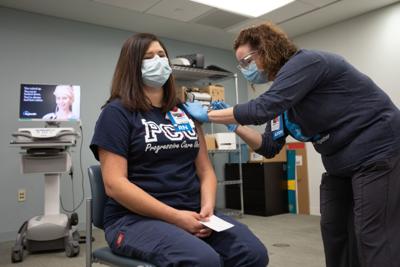
DELAWARE - The first dose of the Pfizer COVID-19 vaccine in Delaware was given on Tuesday. A progressive care unit nurse at Bayhealth Dover, Elisabeth Cote, was vaccinated 24 hours after the vaccine arrived at the hospital.
Beebe Healthcare could begin vaccinating as soon as Wednesday afternoon.
There has been a lot of concerns about the vaccine, but the state says Pfizer has done rigorous testing through three clinical trials. Healthcare workers say the vaccine offers hope.
Dr. Kelly Abbrescia, emergency medicine specialist at Bayhealth Hospital, also got the shot Tuesday morning.
"I would not have gotten the vaccine if I didn't think it was completely safe and completely appropriate. I feel very strongly about that,” said Dr. Abbrescia.
Doctors from Beebe and Bayhealth answered some commonly asked questions about the Pfizer vaccine.
How does the vaccine work?
"A lot of vaccines use live virus, or attenuated killed virus, this doesn't even do that. It just uses that spike protein, we've all seen the little COVID ball. It just uses that spike protein and teaches your body to fight the virus," said Dr. Abbrescia.
Some people may experience side effects like arm soreness, headaches, fatigue and fever.
"The job of the vaccine is to boost your immune system, and that boosting of your immune system can sometimes make you feel crummy, or give you those things,” said Dr. Bill Chasanov, Beebe Healthcare’s infectious disease doctor and COVID-19 Response Medical Director.
What are the severe side effects? What about allergic reactions like those in the United Kingdom?
"They're looking further into that and it appears those individuals have an issue of having a severe allergic reaction to something else. So beyond that it doesn't appear that is very common and still is a quite rare complication or side effect, but does appear the two individuals may be linked to the vaccine,” said Dr. Chasanov.
He says any severe side effects are being monitored and reported.
Dr. Chasanov added, "Some of the news and media state there have been a few cases reported of Bells Palsy after receiving the vaccine. But those numbers are so low that at this point they're not really causal. Meaning we cannot link the vaccine to Bells Palsy.”
How long will immunity last?
"It's one of the million dollar questions, because is this vaccine going to be something we're going to need to get yearly? Is this vaccine once and done? Or is this vaccine something we'll need to be booster-ed for every so often ... So I do not believe anyone has the answer to that because the vaccine hasn't been out long enough to answer those questions,” he said.
Dr. Chasanov says returning to some kind of normal all depends on the number of people who get vaccinated.
"80 percent of the population will need to have some type of immunity in order to provide the protection for many of us in what we call the "herd,” said Dr. Chasanov.
