





SpaceX is launching Starship into orbit on its boldest test yet, a 22-hour flight that aims to recapture the entire rocket at the Texas pad. Everything is on track for the planned Friday launch, pending approval from federal regulators. Elon Musk's company will attempt to return the booster six minutes after liftoff, followed the next day by the bullet-shaped spacecraft in what would be a momentous first. Giant mechanical arms will be used to pluck each segment in midair. The spacecraft will deliver 26 Starlink satellites to orbit, then complete 15 laps around Earth before tackling the grand finale.
From
To

A Japanese spacecraft is rocketing toward Mars on an unprecedented quest to explore its mysterious moons and bring back samples. Japan launched it before dawn Tuesday from the country's main spaceport. Five of the world's space agencies have joined forces for the five-year mission that will attempt to land a robotic prospector plus a rover on Phobos, the larger of Mars' two moons. While NASA and China have successfully landed spacecraft on Mars, no one has ever ventured onto Phobos or its sidekick Deimos and no one has managed to fetch samples. If successful, Martian lunar soil and small rocks will arrive at Earth in 2031.

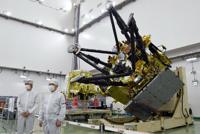
The Japan Aerospace Exploration Agency unveils a spacecraft for its Martian Moons eXploration mission at the Tanegashima Space Center in Minamitane, southwestern Japan, Aug. 13, 2026. (Yuika Kawazoe/Kyodo News via AP)

This photo provided by NASA/JPL-Caltech/University of Arizona, taken with NASA's Mars Reconnaissance Orbiter, shows Phobos, one of Mars' moons, on March 23, 2008. (NASA/JPL-Caltech/University of Arizona via AP)