




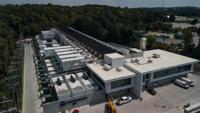
The 400 largest data centers in the United States put as much heat-trapping gas in the air in one year as the nation of Denmark. And that was before the artificial intelligence boom really got going. Harvard University researchers published the analysis Monday. Meanwhile, negotiators at the United Nations COP31 climate talks in Antalya, Turkey, launched a voluntary pledge on Monday for companies and countries to require those data centers to use clean power. The pledge also calls for directing the power of artificial intelligence to help solve the problem of climate change.
From
To

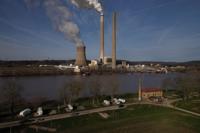
Emissions of heat-trapping carbon dioxide from the burning of fossil fuels decreased slightly this year due to the Iran war. It’s only the third decrease in carbon pollution this century. Experts believe this is not the long-sought bending the curve of emissions. Instead, they think it is temporary like the previous drops during the COVID-19 pandemic and the 2008 recession. The world is still putting more than 1,300 tons of carbon dioxide into the air every second. Pollution went down about 1% in the U.S., China and Europe.
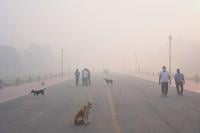
A thick blanket of smog has shrouded India’s capital after firecrackers lit up the skies over New Delhi during Diwali celebrations. Despite restrictions, residents celebrated with fireworks on Sunday evening, worsening the city's already high pollution levels. The air quality index exceeded 350 in several parts of the capital on Monday morning, reaching the severe category. India's Supreme Court has tried to limit Diwali pollution by restricting conventional firecrackers, but enforcement remains a challenge. New Delhi, home to over 30 million people, regularly ranks among the world’s most polluted areas during winter, with pollution worsening in late October and November.

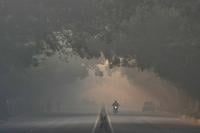
A motor cyclist drives through thick smog after firecrackers lit up the sky overnight during Diwali celebrations in New Delhi, Monday, Nov. 9, 2026. (AP Photo/Manish Swarup)

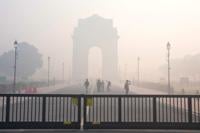
People walk in front of India Gate, shrouded in thick smog after firecrackers lit up the sky overnight during Diwali celebrations, in New Delhi, Monday, Nov. 9, 2026. (AP Photo/Manish Swarup)

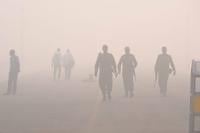
Security personnel walk through thick smog after firecrackers lit up the sky overnight during Diwali celebrations in New Delhi, Monday, Nov. 9, 2026. (AP Photo/Manish Swarup)

People walk through thick smog after firecrackers lit up the sky overnight during Diwali celebrations in New Delhi, Monday, Nov. 9, 2026. (AP Photo/Manish Swarup)
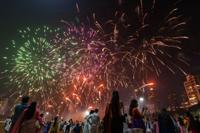
For people across South Asia, especially in northern India, Diwali celebrations coincide with the return of hazardous winter air, raising concerns about how to celebrate safely. Winter also brings severe smog to parts of Pakistan and China, where warmer air can act as a lid that traps colder air and pollution near the ground. Experts suggest practical ways for people to protect themselves. Understanding how pollution is measured, finding reliable air-quality websites and apps, and choosing effective masks can help reduce exposure. Knowing what to look for in an air purifier, its benefits and limitations, and affordable ways to stay safer indoors without one can offer further protection.

FILE - Fireworks light up the sky during the festival of lights Diwali in Mumbai, India, Oct. 20, 2025. (AP Photo/Rafiq Maqbool, File)

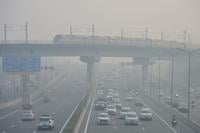
FILE - Traffic moves through dense smog in New Delhi, India, Nov. 4, 2026. (AP Photo/Sanjeev Rastogi, File)