



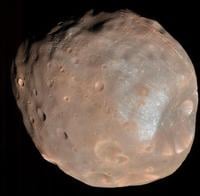
A Japanese spacecraft is rocketing toward Mars on an unprecedented quest to explore its mysterious moons and bring back samples. Japan launched it before dawn Tuesday from the country's main spaceport. Five of the world's space agencies have joined forces for the five-year mission that will attempt to land a robotic prospector plus a rover on Phobos, the larger of Mars' two moons. While NASA and China have successfully landed spacecraft on Mars, no one has ever ventured onto Phobos or its sidekick Deimos and no one has managed to fetch samples. If successful, Martian lunar soil and small rocks will arrive at Earth in 2031.
From
To

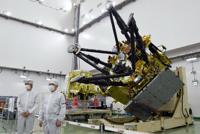
The Japan Aerospace Exploration Agency unveils a spacecraft for its Martian Moons eXploration mission at the Tanegashima Space Center in Minamitane, southwestern Japan, Aug. 13, 2026. (Yuika Kawazoe/Kyodo News via AP)

This photo provided by NASA/JPL-Caltech/University of Arizona, taken with NASA's Mars Reconnaissance Orbiter, shows Phobos, one of Mars' moons, on March 23, 2008. (NASA/JPL-Caltech/University of Arizona via AP)


This image taken from video by NASA shows a SpaceX capsule carrying four astronauts docking at the International Space Station, Thursday, Oct. 1, 2026. (NASA via AP)


Four astronauts are on their way to the International Space Station following a Florida liftoff. SpaceX launched the U.S., Canadian and Russian crew on Thursday. Although their space station stay will last a long six months, the flight there promises to be the quickest yet for Elon Musk's company. Commander Jessica Watkins and her crew should arrive at the orbiting lab in a mere eight hours, well before bedtime. Watkins is the first Black woman to lead a crew to orbit. Also on board: Canadian Joshua Kutryk, whose wife will give birth to their third child while he's away.

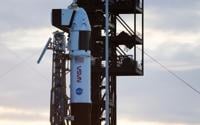
A SpaceX Falcon 9 rocket with the company's Dragon spacecraft on top is seen at sunset on the launch pad at Space Launch Complex 40 as preparations continue for the Crew-13 mission, Wednesday, Sept. 30, 2026, at Cape Canaveral Space Force Station in Florida. (Joel Kowsky/NASA via AP)


SpaceX launched its enormous Starship toward orbit for the first time Monday, aiming for six full laps around Earth to prove its readiness for…


Seagulls fly near the site of SpaceX's mega rocket Starship as it is prepared for a test flight from Starbase, Texas, Sunday, Sept. 27, 2026. (AP Photo/Eric Gay)

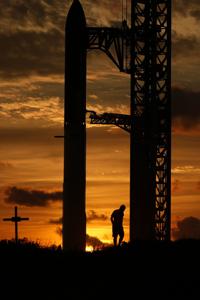
A man watches at sunset as SpaceX's mega rocket Starship is prepared for a test flight from Starbase, Texas, Sunday, Sept. 27, 2026. (AP Photo/Eric Gay)


David Orr camps out near the site where SpaceX's mega rocket Starship, behind right, is preparing for a test flight from Starbase, Texas, Sunday, Sept. 27, 2026. (AP Photo/Eric Gay)