



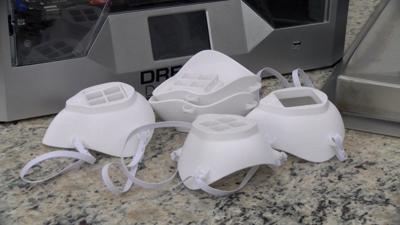
LEWES, Del. - The State of Delaware and its healthcare organizations are preparing for a surge of COVID-19 cases. Cyber Streets uses technology to tackle community-wide issues on a regular basis and now it's making 3D printed masks for healthcare workers who don't work directly with COVID-19 patients. The masks can supplement N95 masks if hospital supplies run out.
Cyber Streets members, including Dover Cyber Ninjas from the Sankofa Inner City Cultural League, and supporters from the Sussex County STEM Alliance and Selbyville Library are using 3D printers to produce masks throughout the community. Several of their printers were funded through a grant from the Verizon Foundation. Founder Rob Bentley says as of Friday, the University of Delaware RDL lab in Lewes is starting production too.
The masks are made out of PLA plastic, which is a fully biodegradable thermoplastic polymer consisting of renewable raw materials. Bentley says it's a popular 3D printing material for additive manufacturing. He says he combined different templates from the medical community to make the masks and that each one can be custom scaled and printed to fit anyone. His goal is to empower others to use technology and to join the fight against COVID-19.
"They're social distancing," Bentley says. "This gives them something to fight for. Now we have our families and our home-school communities reaching out and literally helping the front lines."
Bentley loaned a 3D printer and filament to the Berberians in Rehoboth Beach a couple days ago.
"The filament goes on the inside of the mask and then you take this other piece, you push it right through, and it snaps right into place, so it creates a filter in the front," says Jack Berberian. "You put it on your face and you're breathing through the filter in the center."
12-year-old Grace Berberian is in charge of plugging in the USB with the template to set up production.
"There's settings once you plug it in," says Grace. "We print them two at a time because we want to help as soon as possible."
It takes 4 or 5 hours to print each mask. Printing two at a time takes about 8 hours. The masks have to be fit tested to each person who wears one. Bentley says they're primarily produced for Beebe Healthcare and that several have already been tested for hospital employees and home nurses who don't work directly with COVID-19 patients.
"We're asking them to use these masks to tell us if these are things we can use in more critical situations down the road and we're asking people who want to try them out, so that we can see just how effective they are, just how comfortable they are when the time comes," says Beebe Healthcare President and CEO Dr. David Tam.
If the supply of N95 masks runs out, Beebe can use the 3D printed masks as supplements.
"It really is a critical aspect of making sure that we have the crisis requirements or resources and also reassurance to our staff so that when things get bad, we will not be like other cities or other communities that have to resort to garbage bags over their head," says Dr. Tam. "We have these other capabilities to make sure they are safe."
Ezra Williams is a technology instructor with both Cyber Streets and the Sankofa Inner City Cultural League, but this is a project he's never seen done before.
"We followed the instructions Rob had given us and they were really simple to follow, so this for me was very straight-forward and fun," says Williams. "It allows for my son and I to come together to talk about 3D printing."
More than 60 masks have been made so far, but Cyber Streets plans to place more 3D printers throughout the community and even in fire stations, which Bentley says will result in more than 700 masks and shields produced within the next few weeks.