



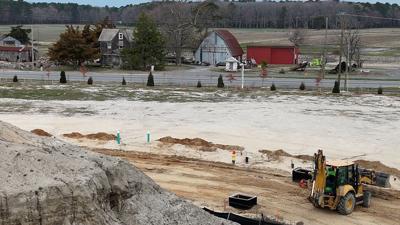

DELMARVA - The sound of bulldozers has become the new background noise of Delmarva. From Lewes to Milton to Selbyville, the rumble of construction equipment mixes with the buzz of tractors as farmland gives way to new neighborhoods, golf courses and shopping centers.
For the families who have worked this soil for generations, each new housing foundation represents another piece of Delaware’s agricultural heritage disappearing beneath asphalt and concrete.
“Less than two years ago, that was just another farm field,” said farmer Chris Magee, looking across the road at a development called Bay Knolls. Where corn and soybeans once stood, homes now rise in neat rows. Magee’s family has farmed in Sussex County since 1865. “This is our family farm. Here is where my family started,” he said, gesturing toward a collection of antique farming equipment that his ancestors once used with mule teams. “This is what you would dig potatoes with,” he explained, running his hand across a rusted cultivator.
Magee hopes his seven-year-old son, Oliver, will someday continue the family tradition. “He enjoys it,” he said. “I just hope the stress and the business aspect doesn’t scare him away.”
The Loss of Farmland Across Sussex County
Sussex County has long been Delaware’s agricultural heart, producing grain, poultry, fruits, and vegetables for centuries. But over the past several decades, development has transformed the region.
A 1953 film produced by the Delaware Development Department described the state as having “over 7,000 farms producing over $100 million in farm products each year.” Today, according to the U.S. Census Bureau, there are just over 1,000 operating farms in Sussex County, despite it remaining the county with the most farmland in Delaware.
Data from the American Farmland Trust shows the eastern half of Sussex County, particularly the corridor between Lewes, Milton, and Millsboro, has seen dramatic conversion of farmland to residential use since 2016. State planning reports show that trend continuing westward toward Seaford and Blades.
“With the increased development in our immediate area, deer and other wildlife have nowhere to go,” said Bennett Orchards owner Henry Bennett, pointing toward fencing now needed to protect his blueberry bushes from displaced animals. “About a decade ago, this wasn’t necessary. We never really had deer problems in our orchard.”
A Family Legacy at Stake
The Bennett's have farmed their land in Frankford since the 1760s, interrupted only by the Civil War. For most of the 20th century, their operation focused on chickens and grain crops, until Henry Bennett’s father made a shift in the 1980s.
“He kind of saw that we had smaller acreage,” Bennett explained. “Moving and transitioning into fruit crops would be not only more profitable but a more sustainable long-term solution.”
Today, Bennett Orchards is known for its peaches and blueberries, made possible by the region’s unique climate. “We have the perfect soil, the perfect climate — what winemakers would call the perfect terroir,” Bennett said. “Our salty sea breeze, sandy soil, temperate climate, and abundant sunshine all make this an ideal place to grow fruit.”
But he worries about the shrinking space available for farming. “Once farmland is sold, it’s never going to be farmland again,” he said. “Every farm that’s sold is lost forever. It’s sad, but it’s the reality we live in.”
From candid conversations with Sussex County farmers to deep dives into decades of state land-use data, anchor Matt Pencek offers a firsthand look at how agriculture is fighting to endure as development reshapes Delmarva, and why preserving farming remains core to the region’s identity.
Across the Border, the Same Story Unfolds
In Worcester County, Maryland, the same trend has farmers worried about the future. “For God’s sake, look at what Sussex County is doing,” said Bishopville farmer Kathy Drew. “They’re just developing it left and right.”
According to the U.S. Census Bureau, Worcester County had 2,334 farms in 1910. By 1969, that number dropped to 785. Midway through the current decade, only 361 remain, a staggering 85 percent decrease over the last century.
Drew’s farm produces soybeans and raises chickens, the backbone of the Lower Shore’s agricultural economy. Her property sits just a few fields away from the Lighthouse Sound development, a golf course community built on what was once pastureland. “That used to be a cattle farm,” she said. “Some of the old-timers can still tell you stories about it. It’s heartbreaking.”
Balancing Growth with Preservation
Delaware’s Agricultural Lands Preservation Program has permanently protected more than 21 percent of Sussex County’s existing farmland, ensuring that those acres will remain agricultural forever. Still, pressures from population growth continue to mount.
State planners project that by 2050, Sussex County’s population will grow by 52 percent. More people will need more homes, which means more farmland could be at risk of being sold for development.
For many farmers, the future of agriculture on Delmarva depends on the next generation’s willingness to stay on the land, and the state’s commitment to protect it.
“We have a four-year-old grandson,” Drew said. “Whether he decides to continue on with farming will be seen in the future.”
Bennett is more defiant. “As you see more and more farms disappear,” he said, “the sell-out-and-shut-up mentality is not going to happen on this farm. We’re going to go for another six generations or more.”
The bulldozers may not stop anytime soon, but for families like the Bennett's, Drews, and Magee's, the fight to preserve the land that defines Delmarva continues, one acre, one generation at a time.
