



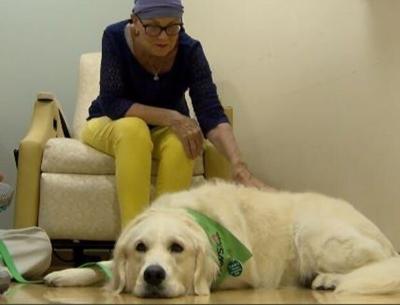
(REHOBOTH BEACH, Del.) - Cancer patients in Rehoboth Beach are now being offered a different kind of treatment, one that doesn't require pills or needles. It's called pet therapy, and instead of using doctors, it uses dogs.
"Patients, especially towards the beginning of their treatments, come in very anxiety ridden and very nervous, but when the dogs come in, there's a sense of calm over them," said Jacki McCave, a radiation therapist at Beebe Tunnell Cancer Center. "They're more laid back. They're not as anxious coming into the treatment room for the first time or for the first week or so. I just noticed a very calm sense feeling about them."
Beebe Healthcare recently partnered with PAWS for People, a Wilmington-based non-profit 501(c)3 pet therapy organization, and now offers pet therapy for its patients, visitors and team members. Studies show spending time with a pet can stabilize blood pressure, lower anxiety and diminish overall physical pain.
"Your mind goes to a different place and your emotions go to a different place," explained Dr. Ray Glick of Lewes. "Just in general, I think it takes the tension out of the air."
Dr. Glick, who's been fighting prostate cancer for nearly one month, says he must come for treatment five days a week for nine weeks straight. He says having a therapy dog around makes visits less stressful.
"I think every time that the dogs come in, I think people relax. I think suddenly their mental attitude is less on themselves and more on, 'ooh, there's a dog and I'm going to pet it,' or the dog is being cute and people enjoy that," said Dr. Glick. "You change even though you don't know you're changing."
The same can be said for Mary K. Ludovicy who was diagnosed with ovarian cancer last March.
"When I'm here for therapy, it's all about me, like how much will I weigh? Will I get a good report? But those thoughts are not on my mind today," said Ludovicy.
For the very first time, Ludovicy was joined by Roxy, a 2.5-year-old English Cream Golden Retriever, and Roxy's handler, Jon Stolson, during treatment. She was pleasantly surprised by the therapy's benefits.
"I'm amazed to say my feelings are a feeling of calmness, and I've just got out of my own thoughts about myself and I'm interested in finding out about her and just petting her," said Ludovicy. "It just makes me feel relaxed."
But patients aren't the only ones who benefit from these special visits.
"[Pet therapy] has done wonders for the staff, as well," said McCave. "Our schedules can get chaotic. There can be a lot of stress going on behind the scenes, and when we see Roxy or any of the other dogs, we all just kind of take a second to just get on the floor and play with them. It brings us a sense of calm and level-headedness, or clear-mindedness I'd rather say, but yeah it's great having them here."
Roxy and Stolson together received special training for healthcare visitations and certification. Stolson, who's been volunteering with PAWS for People for about one year, says each therapy dog is trained on etiquette and how to interact with patients.
"They'll be exposed to things such as noise, wheelchairs, crutches, patients that might yell at somebody, elevators... different types of things that dogs are going to be exposed to in the different settings and experiences they'll have," said Stolson.
Today, PAWS for People visits more than 140 sites throughout a four-state region, including hospitals and nursing homes in Delaware, Maryland, Pennsylvania and New Jersey. But according to Stolson, that's not enough to keep up with the area's demand.
"Most of the teams are up in the Philadelphia and in the Wilmington and Newark areas. We're trying to get as many as we can down here in the Sussex area because there's a demand, there's a need," said Stolson. "It's not only here in the Lewes, Rehoboth area, it's also over in the Seaford area, Salisbury, a lot of places where the dogs are needed. Some nursing homes now, and even some more hospitals besides Beebe, are really thinking about getting into the program because they find it's beneficial."
To learn more about PAWS for people or to volunteer, visit www.pawsforpeople.org.
