



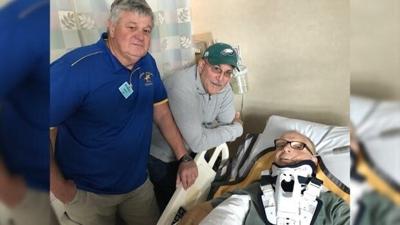
(LEWES, Del.) - It's been eight months since 74-year-old David Robinson's bicycle accident that left him fully paralyzed from the neck down. He was an avid bicyclist for 25 years.
"It happened on DuPont Avenue, just a side street in Lewes," recalled Robinson. "I was alone, and I woke up on the road face down with my helmet split down the center. Shortly after I regained consciousness, I realized I couldn't move anything below my neck."
That's when a passerby noticed Robinson and immediately called for help.
"The ambulance came right away and took me to the hospital where I was airlifted to Thomas Jefferson Hospital in Philadelphia," said Robinson.
For three months, Robinson spent his days at Magee Rehabilitation Hospital. He now suffers from a severed spinal cord and ruptured vertebrae, and believes a blood disorder known as myelodysplastic syndrome, or MDS, is what caused him to suddenly pass out.
"Without wearing a helmet, I would either have a severe traumatic brain injury or I would be dead."
While a helmet saved Robinson from further injury, the same can't be said for many other older adults in Sussex County.
"We see seniors who are much more active than they ever were before, and one of the issues with seniors is they tend not to wear helmets, so we see more head injuries," said Dr. Paul Cowan, Chief of Department of Emergency Medicine at Beebe Healthcare.
According to Dr. Cowan, seniors who are on blood thinners and choose to not wear a helmet while riding a bike have a higher risk of getting intracranial hemorrhage. When asked why seniors tend to not wear helmets, he believes it's because of cultural differences.
"When these seniors were riding bikes when they were 10, 12, 15 years old, nobody wore helmets. Now, if you're under the age of, say 40 or 45, you either were wearing a helmet or should have known to wear a helmet, but most seniors didn't have that sort of safety thought when they were younger so they tend not to wear helmets now," explained Dr. Cowan.
Robinson agrees.
"I see lots of people coming off the trails without helmets on... I think many people are casual riders and are not riding seriously and think 'I'm just out' so they don't wear helmets."
Thinking back, Robinson says he's just thankful to be alive.
"I'm very blessed to be where I am and being able to enjoy life and my grandchildren," smiled Robinson.
Today, Robinson says he would like to thank the person who found him the day of his accident, but there's just one thing - he doesn't know who or where that person is.
"They just sort of disappeared, so I really didn't know who that person was," said Robinson. "I would like to know so I can thank them or them out to dinner, or reward them in some way for rendering help to me when I needed it."