



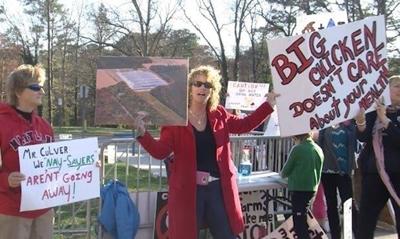

(SALISBURY, Md.) - Protesters outside of the Civic and Youth Center in Salisbury waved signs denouncing commercial poultry farm expansion in Wicomico County ahead of a public forum meeting Tuesday night.
They're part of the newly organized Concerned Citizens Against Concentrated Animal Feeding Operations, otherwise known as CAFOs. Gabby Cammarata founded the group earlier this year.
"Some of the biggest concerns are air quality," said Cammarata, "there's a diminished air quality because of all the fumes, gases, dust, litter that are produced out of the fans."
Protesters shouted and shook their signs at poultry industry leaders and supporters as they entered the civic center for the meeting just before 6 p.m., including the Executive Director of the Delmarva Poultry Industry, Inc. Bill Satterfield.
"There are claims that people are going to get sick or die because they're near chicken houses; that's folly," said Satterfield at his Georgetown office ahead of the meeting Tuesday.
"There are a lot of people who've grown chickens, living on the farms, next to the houses for decades. And they seem to be reasonably healthy. I think there's a great misunderstanding," said Satterfield.
Nicole Kopnisky of Rockawalkin was overtly vocal about her opposition to commercial chicken farm expansion due to what she believes poses contamination threats to the local water supply.
"I'm just concerned about water health, air quality and soil," said Kopnisky. "I have children and I worry about how this is going to affect their health."
At the forum, Maryland state agricultural, environmental and health experts fielded questions written by audience members.
Some questions were about whether there any known cancer clusters associated with CAFOs, which the Director of Environmental Health Bureau offered to answer.
"I'm unaware of any clusters of cancers that have been brought to my attention or the department's worked on that even have been raised to the context of animal feeding operations."
Other questions were about how many chickens can Wicomico handle but the answer made by a Department of Agriculture executive left the audience wanting.
"I'm not going to speculate," said Dave Mister, "I simply cannot answer the question."
When the most important question of the night was posed, why are commercial chicken houses allowed to be built so close to homes, silence fell over the panel. In a delayed response, Mister said it was a local zoning issue.
Satterfield offered an answer to WRDE before the meeting.
"The chicken houses are being planned and being constructed in agriculturally zoned areas where they legally are permitted. These are agricultural buildings in agriculture zones," said Satterfield.
A special work session to discuss poultry houses is set for Monday, Mar. 28 at 10 a.m. in the Government Office Building in Room 301. All interested parties are encouraged to attend.
