



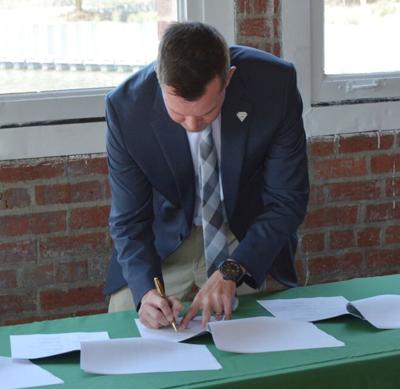

DELAWARE- Delaware State Forester Kyle Hoyd joined forestry leaders from across the Chesapeake Bay watershed last week to renew an agreement focused on conserving, restoring and managing forests throughout the region.
The renewed Chesapeake Bay Shared Stewardship Agreement builds on an agreement first signed in 2020. The memorandum of understanding brings together the U.S. Forest Service and forestry agencies from Delaware, Maryland, New York, Pennsylvania, Virginia and West Virginia, along with Washington, D.C.
The partnership is designed to coordinate forest management and restoration efforts across state and jurisdictional boundaries.
“The saying, ‘work for the land and it will work for you,’ fits this agreement perfectly,” Hoyd said. “From wood products we use daily to clean water, it is our job as forestry leaders to ensure working forests remain a viable option to support our forest ecosystems.”
Delaware state leaders say forests play an important role in the Chesapeake Bay restoration effort by supporting water quality, wildlife habitat, recreation and the regional forest economy. The renewed agreement also supports goals in the 2025 Chesapeake Bay Watershed Agreement, which identifies Healthy Forests and Trees as an important part of the region's long-term restoration strategy.
Delaware's implementation will emphasize science-based forestry practices on public and private land. The approach aims to address forest health, tree regeneration, water quality, wildlife habitat and the long-term sustainability of working forests.
The Chesapeake Bay watershed covers about 64,000 square miles and includes more than 18 million people. About 80 percent of its forests are privately owned, making private landowners important partners in forest conservation.
From 2013 through 2022, about 176,845 acres of forest were converted to development across the watershed, according to the Delaware Forest Service.
About 30 percent of Delaware is within the Chesapeake Bay watershed, covering portions of all three counties. Waterways in those areas eventually drain toward the Chesapeake Bay, making Delaware part of the region's broader conservation effort.
The renewed agreement will give Delaware forestry leaders additional opportunities to coordinate with neighboring states and federal partners while supporting landowners and healthy, productive forests.
