



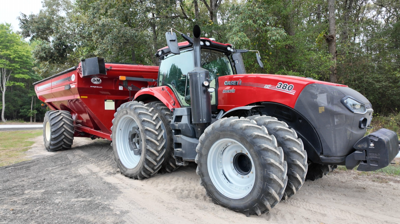

HARBESON, Del. — For Brad Ritter, the sound of harvest is also the sound of money being spent.
The diesel engines powering his combines, tractors and trucks run for hours during corn and soybean harvest, burning through hundreds of gallons of fuel each day.
“Everything we have on the farm is diesel,” said Ritter, a fourth-generation farmer who's family operates Ritter Farms in Harbeson. “We figure we're probably using about 125 to 250 gallons of fuel a day. And it's a big chunk of change each day.”
Ritter Farms is now in the middle of harvest, with about 700 acres of corn and another 700 acres of soybeans still to go. The farm tills roughly 1,400 to 1,500 acres, most of it rented ground.
The higher cost of diesel is adding another expense at one of the busiest times of the year.
“It's just a part of the operating expense and we deal with it the best we can,” Ritter said.
According to AAA, the national average price for a gallon of diesel recently reached $6.51, an all-time record high. Prices in Delaware are lower, but the cost is still putting pressure on farmers who depend on diesel-powered equipment to get crops out of the field.
Ritter said he has changed the way he buys fuel because of the volatility.
“We're only buying a small amount at a time, hoping that in the near future the prices will go down and then we'll be able to top off,” he said.
The farm has a tank capable of holding about 4,000 gallons. But Ritter said he isn't filling it to capacity.
“We probably buy 1,000 gallons at a time, maybe every 10 days,” he said. “We just won't top that off right now. That's just too much of a big expense to hit, to break that check at one time.”
Instead, Ritter is looking for small ways to cut fuel consumption.
“We try to be as efficient as we can,” he said. “We don't leave equipment running a long time. We try to shut it down.”
During harvest, even a truck waiting at a stoplight or a four-way stop can mean an engine continuing to burn fuel.
But fuel is only one of the challenges facing farmers this season.
Weather is another major concern. Ritter said drought and heat stress earlier in the growing season weakened some of his corn, leaving the stalks more vulnerable to strong winds and storms. Once a crop is on the ground, Ritter said, harvesting it becomes much more difficult.
“We lose it. It's just a no-win situation when the crop is on the ground,” he said.
Wet conditions can create another problem. Ritter said soybeans can absorb moisture quickly, and harvesting them too wet can lead to additional drying costs.
Through it all, Ritter said farmers have little choice but to keep going.
“What choice do we have?” he said. “It's just a part of doing the business. We can't control the price. So we're at the mercy of it. We do the best we can.”
Despite the challenges, Ritter said he still loves farming.
“Oh, it'll pull your hair out some days,” he said. “Some days I just want to say, I've done this long enough.”
But then he looks at what the work produces.
“Other days, you sit back and you look at a field, you watch it go from a seed to a beautiful plant to where you're just getting a tremendous yield,” Ritter said. “It's like, yeah, we did that. We did that. That is just a great feeling.”
Ritter said that feeling is what keeps him going.
“Everybody asks, why do you want to farm? Why do you want to do this?” he said. “That's the thing. I mean, you can actually physically see something grow.”
He expects the farm will produce a good crop, even if it isn't a great one.
“We're not going to have a great crop, but we're going to have a good crop,” Ritter said. “And that's the name of the game. I mean, it's being consistent.”
And despite being nearly 65, Ritter doesn't see himself walking away anytime soon.
“I love doing it," Ritter said.
For Ritter, that connection to the land goes beyond the harvest itself. The farm also sells sweet corn locally, giving customers a direct connection to where their food was grown.
“Everybody comes up and it's like, ‘Was it grown here?’” Ritter said. “Yeah, it was grown here. I've taken care of it. I'm selling it here. There's nothing like that.”
