



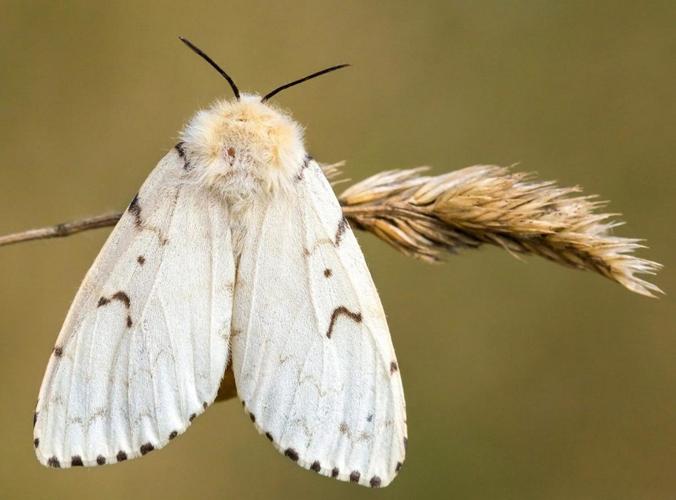

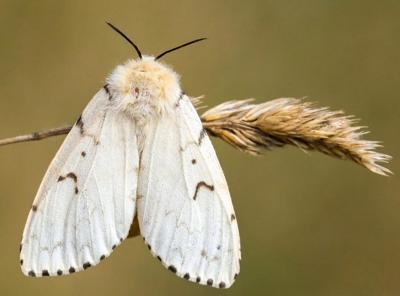
DOVER, Del. - The Delaware Forest Service has detected 825 acres of leaf loss around the Cypress Swamp, Gumboro, and the Nanticoke Wildlife Area due to gypsy moths. The Service says this is a massive increase, as leaf loss only covered around 12 acres in 2021.
The Service says that the trees most threatened from the leaf loss by the gypsy moth are very old or stressed oak trees. They say white oaks are preferred by the moths, but many other deciduous trees experience leaf loss by them as well. They also say that evergreen trees are safe for the most part.
The Forest Service says that healthy trees can usually survive a year of affliction, but two or more are a concern for the tree's health.
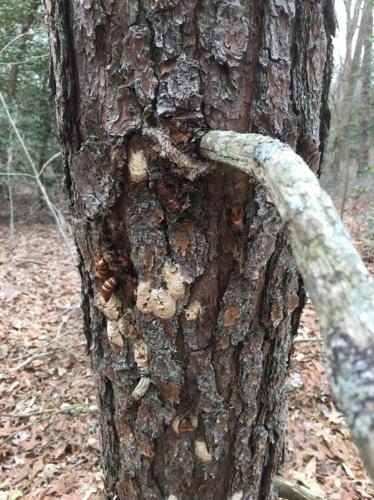
According to the Service, the leaf loss, or defoliation, can be predicted by counting the number of egg masses per acre. They say that the masses can be found on pretty much any man-made or natural surface exposed outside during the previous June and July, so they recommend careful searching. The egg masses are the only life stage of the moths to be seen during fall and winter, says the Service, and will have a yellow-brown color that is firm to the touch.

Gypsy moth egg masses (1 to 2 inches long) and darker brown pupal cases on a loblolly pine trunk from Phillips Landing, DE. March, 2022. Bill Seybold.
The Delaware Forest Service says that some egg masses from the previous year will stick around and have a whiter, bleached color filled with holes and tatters. They say that people may find empty pupal cases from the previous summer as well, but they are not a living part of the insect population. More information on how to predict how much defoliation to expect next May and June, can be found at the Delaware Forest Service – Forest Health page.
There is a natural biological control agent from the Japanese Fungus Entomophaga maimaiga, but since it is weather dependent, it is difficult to predict if it will control the population by Spring 2023, says the Forest Service.
The Service says that landowners can take control in to their own hands in a few different ways. They say that the masses can be removed and destroyed, or the can be coated by certain sprays that suffocate the eggs and deliver insecticides. In the Spring, they say larval development can be stopped with various insecticides. When treating, the Service says you should make sure to use a federally approved product for spongy (gypsy) moths, and make sure to follow the label when applying the product.
The Forest Service says the most common option for deciduous forests is to aerially spray the young larvae, usually in May, when the leaves of the oak trees have elongated at least an inch, and the larvae are in the first and second stages of growth. They say the size of the aerial spray should be 20 acres or more, because health caterpillars from unsprayed woodlands next to the sprayed area will drift in to smaller areas and cause almost the same amount of damage if not sprayed.
Typically, the Forest Service says the decision to aerially spray needs to be made by January, due to the need to contract a spray job with the small number of licensed applicators in Delaware. Forest landowners who suspect they may have enough egg masses per acre to warrant a privately contracted spray may call the Forest Health Specialist at (302) 698-4553 for technical assistance. Currently, the Delaware Department of Agriculture does not have an organized spray program with financial assistance, says the Service.
The Forest Service says that for yard trees and smaller woodlots, control methods can be found on the internet with a simple search. They do note, however, that not all websites have the same level of professional review before they are published. The Delaware Forest Service strongly recommends using a web site created by a University Extension system, or a federal or state government entity.
Visit USDA’s Animal and Plant Health Inspection Service’s Pest Identification page to learn how to identify the gypsy moth in its egg mass, larval, pupal and adult moth stages.