




DELAWARE - The U.S. government has filed a lawsuit against the University of Delaware and its Board of Trustees, challenging a university policy involving eligibility for in-state tuition.
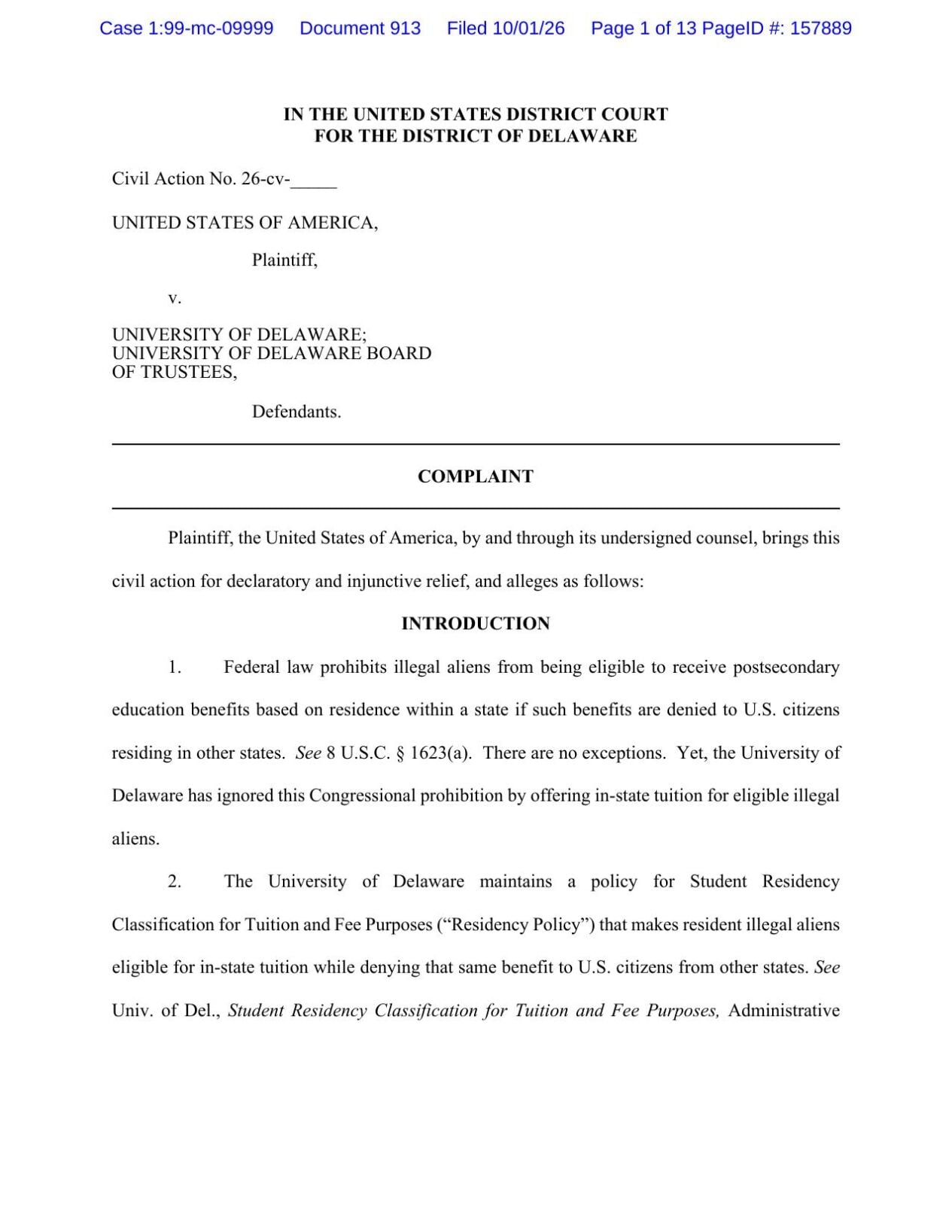
The complaint, filed Oct. 1 in U.S. District Court for the District of Delaware, challenges Section VII of the university's Student Residency Classification for Tuition and Fee Purposes policy.
According to the complaint, the policy allows students who are not lawfully present in the United States to qualify for in-state tuition if they meet certain requirements.
The complaint says those requirements include attending a Delaware high school for at least three years, graduating from a Delaware high school or receiving a GED, living with a parent or legal guardian while attending high school, enrolling at the University of Delaware within 18 months of graduation and providing evidence of an application for U.S. citizenship or permanent residency.
The federal government argues the policy violates federal law because, according to the complaint, it allows students who are not lawfully present to receive in-state tuition based on Delaware residency while U.S. citizens who are not Delaware residents are not eligible for the same benefit.
The complaint cites 8 U.S.C. § 1623(a), which provides that a person who is not lawfully present in the United States cannot be eligible for a postsecondary education benefit based on state residency unless a U.S. citizen or national is eligible for the same benefit regardless of residency.
The federal government also argues the university's policy violates another federal law because, according to the complaint, the benefit is provided through a university policy rather than an enactment of state law.
The complaint says the University of Delaware charges approximately $15,740 in annual tuition for Delaware residents and approximately $42,470 for nonresidents.
The U.S. government is asking the court to declare the policy invalid and permanently prohibit the university from enforcing it.
The allegations are contained in the federal government's complaint and have not been established by a court.
