



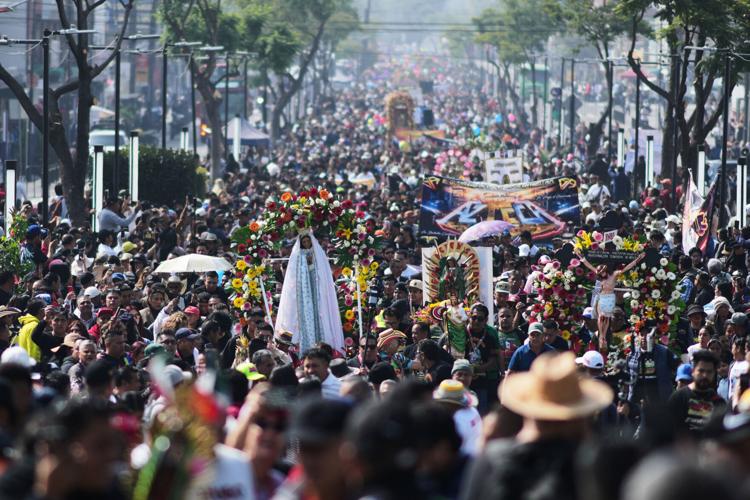
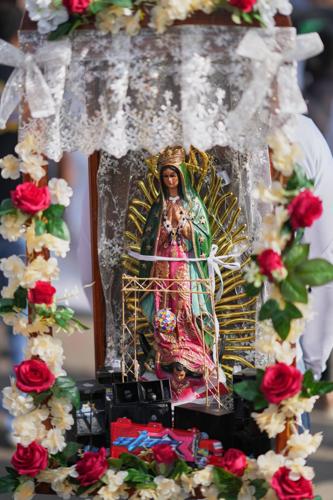
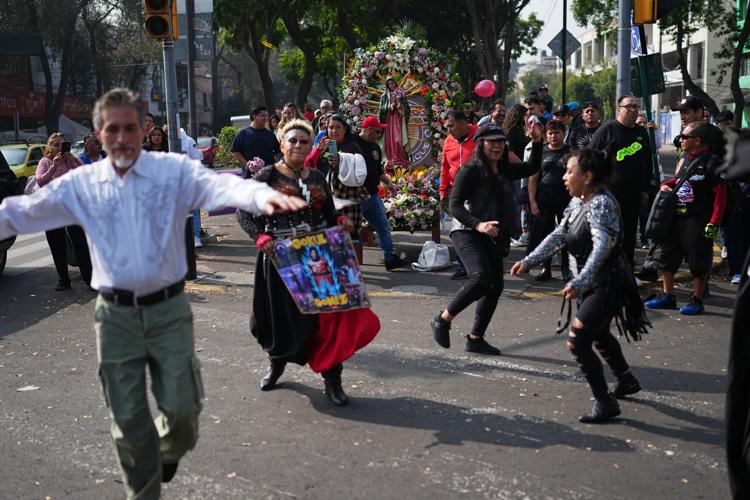
MEXICO CITY (AP) — A sea of people carrying statues of Mexico's patron saint, the Virgin of Guadalupe, marched along the avenue leading up to the country's most important basilica on Wednesday.
Such pilgrimages are practically embedded in the daily rhythms of the bustling Mexican capital. But the roughly 1,000 pilgrims from across the Latin American nation aren't just Catholic devotees.
They're also Mexican street DJs.
The annual procession and street party known as the “sonidero" pilgrimage is perhaps one of the most Mexico City-esque convergences of celebrations to hit the city.
Sonideros, as they're known, are a particular brand of DJs found primarily in Mexico City, but also in other parts of Mexico and Colombia. The DJs mix rhythmic tunes of cumbia with radio announcements, chanting shout outs that mingle with the music.
The tradition is so important in the city, particularly in working-class neighborhoods, that in 2023 the city government recognized sonidero culture as intangible cultural heritage — a designation UNESCO quickly celebrated. The music has even evolved into its own dance, a derivation of cumbia that has more open steps meant for street parties than the classic two-person cumbia.
Each neighborhood has its own set of sonideros who organize pop-up mobile parties. Wednesday's party-procession on the avenue leading up to the famed Basilica de Guadalupe wasn't so spontaneous, but rather part of an annual celebration now spanning decades.
“The root of faith in Mexico is the Virgin of Guadalupe,” said Christian Castañeda, a musician who joined the throngs of people marching through the gates of the Basilica. “We mix this party with the joy of music and we come to play for the Virgin.”
Nearly 80% of Mexicans identify as Catholic, according to Mexican census data, and Mexicans from as far as northern Baja California flock to the capital each November to give thanks for good luck they've had throughout the year.
Esperanza Rivera, donning a bright gold and neon blue t-shirt with images of different radio sets, said she started preparing for the march before the sun came up. At 4 a.m. the 76-year-old began packing sandwiches and putting the final touches on a massive pink altar her family planned to carry through the streets.
Some families see the march as a way to pass down sonidero and religious traditions to the next generations. Others enjoy the chance to connect with other street DJ communities from across the country.
“Everyone, all of the sonideros, unite on this day,” she said.
They walk for hours, using motorcycles to cart a mix of flower-lined altars like Rivera's and mobile DJ booths.
Rivera and her relatives joined a mass in the Basilica before returning with other sonideros by bus to their neighborhood of Tláhuac in the city's outskirts.
That's where they continue the party.
——
Megan Janetsky contributed to this report from Mexico City.
Follow AP’s coverage of Latin America and the Caribbean at https://apnews.com/hub/latin-america
