




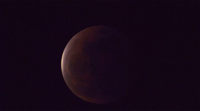
The longest partial eclipse in nearly 600 years will be visible tonight on Delmarva and across half of the world.
Laurel middle school science teacher, Charles Fulco, explains the reason why the eclipse will be so long in duration.
Fulco says, "This eclipse takes place at the moon's apogee in its orbit, which means it's about as far away from the earth as it could possibly be, which, and also at that point, it's moving slower-- more slowly in its orbit. Hence, you get a very long duration of almost totality."
The partial eclipse will begin at 2:18 am, when the moon will fall within earth's partial shadow.
The eclipse will peak at 4:03 am, when ninety-seven percent of the moon will be within the darkest part of the earth's shadow, which is called the umbra.
At 5:47 am, that will mark the end of the lunar eclipse, for an approximate duration of three hours and twenty-eight minutes.
Unlike solar eclipses, lunar eclipses are perfectly safe to watch with the naked eye, without the need for a solar viewer.
So is the lunar eclipse worth waking up in the middle of the night for?
According to Fulco, "It’s just a beautiful sight and the benefit of this eclipse is you’re gonna have those seven sisters. The Pleiades, next to the moon and we have the Leonids meteor shower, uh almost, uh taking place. So you may see a few Leonid meteors along the way, too."
Weather permitting, the moon will appear blood red during the eclipse.
