



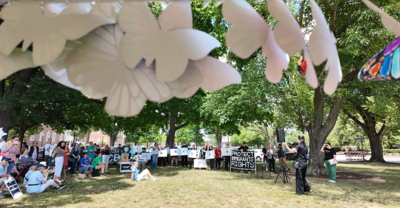


DOVER, Del. - Dozens of community members, including advocates from the ACLU of Delaware, Indivisible Newark, and Indivisible Central Delaware, rallied on the west lawn of Legislative Hall on Wednesday, June 17, calling on lawmakers to pass immigration-related legislation before the Delaware General Assembly's session ends in less than two weeks.
Organizers displayed more than 800 decorated paper butterflies representing immigrants detained by U.S. Immigration and Customs Enforcement in Delaware between January 2025 and March of this year, according to the ACLU of Delaware.
"We were able to use some really great public resources, put together, find the research, find the number, find the 800 for that January through March period," said Helen Salita, immigrants campaign manager with the ACLU of Delaware. "But we know that there have been more people since then, and that just shows how big the problem here is."
"Families are being ripped apart, communities are being ripped apart, and we are trying to draw attention to that while we are advocating for policies that are going to make a real difference for people right now," Salita said.
Salita explained that the butterfly display drew participation from communities across Delaware.
"We are seeing ICE active every single day in every single county, and that is why we had people from every single county come together at different events to decorate these butterflies," Salita said.
Several speakers addressed the crowd, including Rep. Mara Gorman, María Matos, CEO of the Latin American Community Center, activist Charito Calvachi Mateyko, Lisa Elena Williams, a social worker at a local school, and Jack Dixon of Sussex Help.
"We have gathered here so that those lives do not go unnoticed, and to show that what the government is doing is not something we love, desire, promote, or wish to accept," Mateyko said.
Advocates continue to push for multiple bills during the final days of the legislative session, which ends June 30.
One of those measures is House Substitute 1 for House Bill 368, which would prohibit local law enforcement from detaining or extending detention solely based on an immigration detainer or civil immigration warrant, with certain exceptions. Those exceptions apply to people convicted of a violent felony, convicted sex offenders, people with two or more driving under the influence convictions, and perpetrators of domestic violence.
The measure passed the House on Tuesday, June 16, in a 23-13 vote and has been assigned to the Senate Judiciary Committee.
State Rep. Jeff Hilovsky, a Republican representing Delaware's 4th District, and State Rep. Valerie Jones Giltner, a Republican representing the 37th District, were among those who voted against the measure.
CoastTV News previously reported that Marvin Mailey Jr., executive director of the Delaware Association of Chiefs of Police, said House Bill 368 creates what he described as a "directional operational conflict" by restricting cooperation with federal partners. The association also expressed concerns that provisions in the bill could put certain federal funding at risk if the measure becomes law.
In response to those concerns, bill sponsor Rep. Mara Gorman said she was not concerned about potential funding impacts. Gorman also noted that similar laws have been in effect in other states since 2019 and said the measure applies only to the Delaware Department of Correction and law enforcement agencies, not federal agents.
Mateyko also addressed lawmakers directly.
"We are here to remind all the legislators that we are watching them, and that they must do their part to defend and protect immigrants; while they cannot change immigration laws, they can and must do what is required of them within the state of Delaware," Mateyko said.
Williams, the daughter of immigrants herself, shared concerns she has heard from students affected by immigration enforcement in the area.
"They have to go to school, leave their families and think, 'Am I going to come back, and where are they going to be? We don't know,'" Williams said.
Dixon said Sussex Help, a volunteer-driven mutual aid effort supporting immigrant families in Sussex County, was founded about six months ago and has helped hundreds of families.
"We started out offering transportation, food, and some clothing because it was winter time, driving people to the store to shop for diapers and formula, but we quickly realized that people were on the verge of being evicted from their homes, and so money became the most important thing," Dixon said.
The group later established the Sussex Help Fund to assist families with housing costs, utility bills, and other expenses.
Dixon explained that the organization's efforts have expanded beyond financial assistance.
"We've also gotten involved on the legal side, trying to identify people who have been taken to see if we can help them at all with habeas petitions, and just try to offer as much support in every way we can to help them keep their heads above water and to help them come up with a plan, with what comes next," Dixon said. "The families were independent up until their family was destroyed, and they only want to be independent again, so our goal is to help them become independent. A lot of the families that we've worked with have become independent and no longer need our support."
Looking at the more than 800 decorated paper butterflies displayed on the lawn, Dixon reflected on what the display represented to him.
"Probably 2,000 children who may not have enough to eat. 800 mothers who don't know what to do unless somebody steps up to help them find their way back to the independence that's been taken away from them. I see families suffering. I see mothers going hungry to try to feed their children. I see people desperate to find out what comes next. I just see families destroyed. 800 families destroyed," Dixon said.
Dixon also called on the broader community to support immigrant families.
"I think that it's important for the entire community, not just immigrants, for all people, of all races, of all colors, to stand up and stand with the immigrant community. They are our brothers and sisters. They're here to work and to contribute and to build. They're not here to take," Dixon said. "I think that the entire community needs to take this as seriously as if it were their own family and stand together with the immigrant community and try to heal this damage that's been done."
Salita said there is still work to do.
"We need to show up for our neighbors. We do not have time to be scared. We do not have time to be slow in our movements and in our thinking. We need to be acting with urgency because we are in the middle of a crisis," Salita said.
