



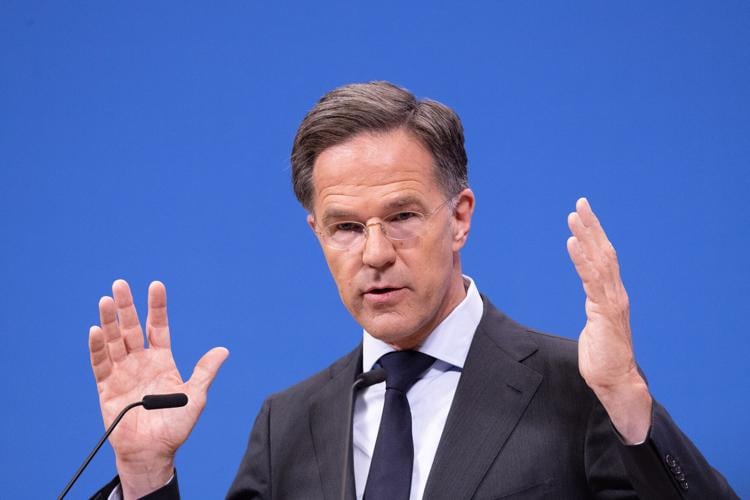
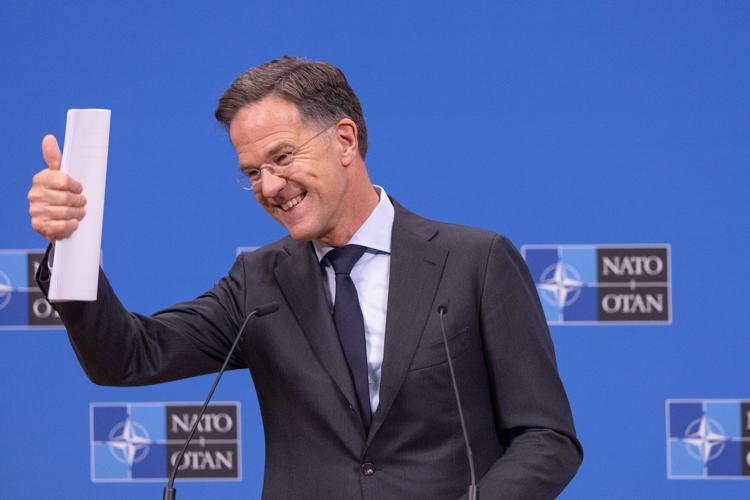
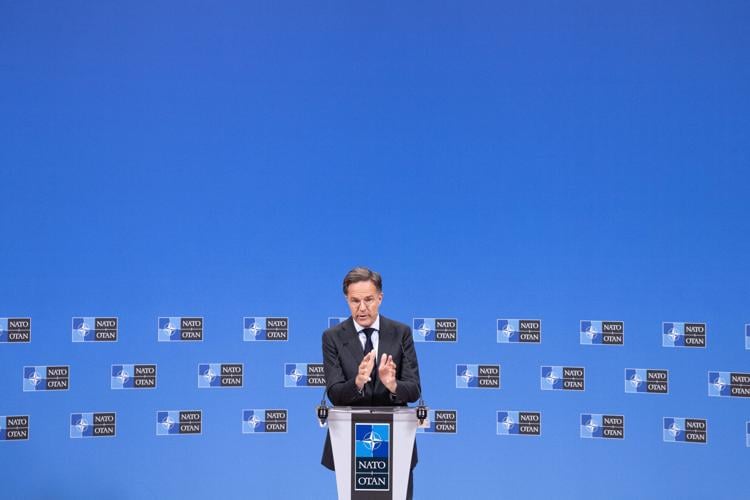

BRUSSELS (AP) — NATO Secretary-General Mark Rutte played down on Wednesday the impact of the Trump administration’s decision to cut back the number of troops and military equipment it would provide its allies should they come under attack.
NATO’s supreme allied commander, an American, is working on backup plans to defend Europe after the U.S. signaled on June 3 that it would no longer supply an aircraft carrier and support ships, aerial refueling planes and dozens of fighter jets, among other military assets, in a crisis.
But Rutte said the U.S. is not withdrawing more troops from Europe. “This is not about where forces and assets are currently located,” he said on the eve of a meeting of NATO defense ministers that he will chair in Brussels.
“It’s about who would do what if our defense plans were activated. So, let’s say in case of an Article 5 situation,” Rutte told reporters.
Under NATO’s collective security guarantee – Article 5 of its founding treaty – the 32 allies pledge that an attack on one of them will be considered an attack on all. It does not oblige them to provide military support, although many likely would.
In essence, the United States is scaling back how it might help should an ally trigger Article 5. The U.S. has by far NATO's biggest armed forces. It does not intend to withdraw its nuclear weapons in Europe, which are key to NATO's deterrence.
Allies are ordered to address U.S. gaps
The so-called NATO Force Model is the alliance's Plan A for making forces from the 32 member nations available in times of peace, crisis or war. It sets out the military assets that commanders can call on in phases over the first six months of any conflict.
Earlier this month, the Pentagon informed its NATO allies that it would no longer provide as much as it focuses on potential threats elsewhere, notably from China in the Indo-Pacific region.
Rutte said NATO’s top commander, U.S. Gen. Alex Grynkewich, believes that “there are largely capabilities available that other allies already have, or will have in the near future,” to fill the U.S. shortfall.
“The overall picture is looking good,” Rutte said.
But some of the equipment being held back has surprised U.S. allies. Much of it is in short supply in Europe. Still, the U.S. wants to know how they intend to replace these assets, or make do without them, by the time President Donald Trump and his counterparts meet for a NATO summit on July 7-8.
Before then, European allies and Canada want to hear more from U.S. Defense Secretary Pete Hegseth about the Trump administration’s plans for the summit in Turkey’s capital, Ankara. Hegseth skipped their last meeting in February.
Trump bewildered the allies last month with plans to send 5,000 additional U.S. troops to Poland, sowing confusion as his administration continued to insist on reducing — not increasing — the U.S. military footprint in Europe.
Cutbacks are occurring in Kosovo
Cutbacks are happening. On Friday, NATO military headquarters announced that it will reduce the size of its security force in Kosovo. U.S. forces are expected to be among those to leave.
The U.S. currently has 590 troops deployed with KFOR there, second only among the 31 contributing nations to Italy with its 907 personnel. U.S. Black Hawk helicopters are also stationed at the sprawling U.S. base there, Camp Bondsteel.
KFOR began deploying in 1999 to keep the peace between Kosovo and Serbia.
Once composed of 50,000 personnel, KFOR has been routinely scaled back over the years as tensions eased, although 1,000 additional troops were deployed in 2023 after fresh violence erupted.
Rutte confirmed on Wednesday that more than 1,000 personnel would leave. Grynkewich has said he believes Kosovo is calm enough now to “optimize” the size of KFOR.
