



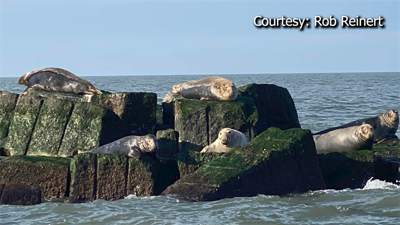
LEWES, Del. - Tourists on vacation aren't the only seasonal visitors you'll find sunbathing on Delaware's beaches. But our guests with four flippers and whiskers usually do it in the winter.
January through April is the MERR Institute's busiest seal season, but one Facebook user captured a photo last week of a couple seals that came out early on the breakwater in Lewes
"We have a large population that is a seasonal the population. They don’t stay year-round, they need to go to colder areas," said Suzanne Thurman, Executive Director of the MERR Institute in Lewes. Though they're not usually sick or injured, it's important to report onshore seal sightings and stay 150 feet away for your safety and the seal's. "If a seal is disturbed and can’t get the rest it needs and is frightened back into the water, it can actually drown," Thurman said. While seals thrive in cold water, this time of year can be dangerous for sea turtles. Marine life rescues often see cases of cold-stunned turtles in the winter. "If it drops below 50 degrees- the water temperature - then the turtles will go into this cold stun state where they become very lethargic. They can even be comatose," Thurman said. MERR found three deceased turtles believed to be cold-stunned last year. We see a good number of turtles in Delaware waters during the summer, but if you see one in the winter, it's probably cold-stunned. "Here in Delaware we have had a few," Thurman said of cold-stunned turtles. "But they’re very prevalent in New England, for example, and of course, in Texas last year when there was a huge freeze. That affected over 10,000 sea turtles." Whether you find a turtle that seems to be struggling or a seal that looks happy as a clam, it's always best to call a marine animal rescue. If you spot marine animal on the coast of Delaware, report it to MERR via their 24-hour hotline at 302-228-5029. For more information, visit
https://www.merrinstitute.org/.
