



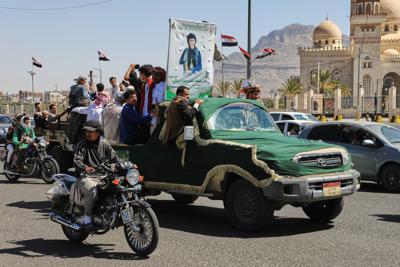
CAIRO (AP) — Egypt's top security body said Sunday it has agreed to support close ally Saudi Arabia in the major escalation of fighting between the kingdom and Iranian-backed Houthi rebels in Yemen, which has marked the latest front in the Iran war.
Saudi Arabia has been pressing allies for military assistance. The Houthis have repeatedly attacked airports and oil infrastructure across the kingdom with drones and missiles that can change direction during flight, posing a challenge to interceptors. At least 19 people have been killed, thousands of flights have been affected and global markets have been rattled.
Also on Sunday, the Saudi defense minister was meeting with the United Arab Emirates president about ways to strengthen cooperation, according to the UAE’s news agency WAM. The countries have had tense relations in the recent past as they backed different factions in the Yemeni coalition fighting the rebels.
The Egyptian announcement on military assistance came a month after a visit by the Saudi crown prince. Chaired by President Abdel-Fattah el-Sissi, the National Defense Council decided to provide “all possible forms of support” to enable Saudi Arabia to defend its security, according to a presidential statement.
It didn’t provide details. El-Sissi on Saturday called for parliament to grant him the authorization to deploy troops and military equipment abroad.
Civilians in both Yemen and Saudi Arabia have died
The surge in fighting has threatened civilians in both Saudi Arabia and Yemen, which has seen a return to civil war. The interim capital of Yemen’s internationally recognized government, Aden, has seen its airport and a palace used by the government attacked in the past week.
On Sunday, an airstrike killed at least nine people, including five children and two women, in Yemen’s rebel-held northern province of Saada, the Houthi-run Health Ministry said.
Spokesperson Anees al-Asbahi said the strike hit a house in Sahar district and wounded 19 others, including 11 children. Some were in critical condition, he said.
Al-Asbahi blamed Saudi Arabia. There was no immediate comment from the kingdom. The Houthi-run al-Masirah satellite channel aired footage of people clearing debris with their hands and pulling two young people out of the rubble.
The rebels said attacks by Saudi-led forces had killed or wounded over 30 people in the past 24 hours. Brig. Gen. Yahya Saree, the Houthis' military spokesperson, said 110 missiles or airstrikes were carried out against civilian sites in Sanaa and other cities. The Associated Press could not independently verify the claim.
Across the border in Saudi Arabia, a Saudi helicopter gunship crashed near the city of Najran in the southwest, killing its two-member crew, a Saudi military spokesperson said, citing a technical malfunction. The Houthis earlier claimed to have downed it.
Later, Saudi Civil Defense authorities said a projectile fired by the Houthis landed in a residential area of Najran province, wounding six people.
Accusations are traded and a call for mediation is made
The Houthis have resumed attacks on Saudi Arabia in recent weeks because the kingdom has supported Yemen’s internationally recognized government in the civil war. The rebels recently seized more territory along Yemen’s Red Sea coast and near the Bab el-Mandeb Strait, a crucial shipping alternative to the Strait of Hormuz.
The Houthis’ chief negotiator on Sunday blamed Saudi Arabia for the escalation. Mohamed Abdulsalam said on social media that the rebels had warned the kingdom against striking the rebel-held Sanaa airport in mid-July.
That strike prevented the landing of an Iranian flight carrying a Houthi delegation returning from the funeral of Iran’s supreme leader, who had been killed in the opening strikes of the war in February.
The Houthis, angry over the longstanding Saudi blockade on them, declared their own blockade on the kingdom.
Oman had offered a five-day truce during which the two sides would meet and settle their dispute, Abdulsalam said. He said the Houthis agreed to stop attacks if Saudi Arabia agreed to “humanitarian demands.” He didn’t elaborate.
He said Saudi Arabia didn’t show “any indication that it is ready to deal positively” with the demands. The rebels shortly after that launched their offensive down the Red Sea coast.
A Saudi diplomat last week in a rare briefing said the kingdom had called for a meeting in Oman with the Houthis in July “to resolve outstanding differences and bring an end to this escalation,” but the rebels refused to participate.
On Sunday, the Sunni Muslim world’s foremost religious institution, Al-Azhar in Egypt, called for the formation of an “urgent mediation committee” to end conflicts across the Arab region.
