


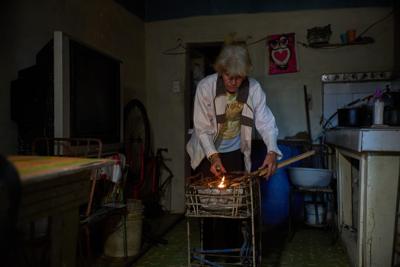

SAN JUAN, Puerto Rico (AP) — The U.S. government on Thursday announced an additional $6 million in aid for Cuba as the island’s crisis deepens and tensions escalate between the two countries, with Cuba's president accusing the U.S. of an “energy blockade."
The aid is largely meant for those living in Cuba’s eastern region, which Hurricane Melissa slammed into late last year. The supplies include rice, beans, pasta, cans of tuna and solar lamps that will be delivered by the Catholic Church and Caritas, said U.S. Department of State Senior Official Jeremy Lewin.
He warned that officials with the U.S. embassy in Cuba will be out in the field “making sure that the regime does not take the assistance, divert it, try to politicize it.”
The U.S. previously sent $3 million in disaster relief to Cuban people affected by Melissa.
Lewin rejected that a halt in oil shipments from Venezuela — after the U.S. attacked the South American country and arrested its then leader — is responsible for the humanitarian situation in Cuba.
He said that for years, the island has “hoarded all of the resources for the few senile old men that run the country, for their henchmen, for the security apparatus” as he accused Cuba of “meddling abroad,” including “colonizing Venezuela.”
“So that’s what they’re spending their time and attention on,” said Lewin, who noted that his mother was born in Havana.
“Why can’t they get food? It’s not because we’re not letting illicit Venezuelan oil continue to make Raúl Castro rich,” he added, referring to the former Cuban president. “It’s because the government can’t put food on the shelves. They have billions of dollars, but they don’t use it to buy food for ordinary Cubans.”
Lewin spoke hours after Cuban President Miguel Díaz-Canel held a rare, invite-only press conference in which he fielded questions from a select group of reporters. The Associated Press was not invited.
Díaz-Canel said that there was a “psychological war” against Cuba as he described a recent threat by U.S. President Donald Trump to impose tariffs on any country that sells or provides oil to Cuba as “an energy blockade.”
He said such actions affect transportation, hospitals, schools, tourism and the production of food. In addition to severe blackouts, Cuban officials note that U.S. sanctions, which increased under Trump's second term, cost the country more than $7.5 billion between March 2024 and February 2025.
“I know we are going to live through difficult times. But we will overcome them together, with creative resilience,” Díaz-Canel said in a two-hour speech in which he answered questions from a handful of reporters.
He noted that Cuba has not received oil shipments since the U.S. began its “naval blockade” on Venezuela in December.
“Therefore, we have problems with fuel availability to guarantee not only electric generation, but also basic activities,” he said.
Díaz-Canel promised that in a week, he would share details regarding the island’s current situation and how the government will confront it.
“There’s a lot of fear,” he said. “I know people say, ‘Sacrifice, again?’ Well, if we don’t sacrifice, and if we don’t resist, what are we going to do? Are we going to give up?”
Lewin said that if the Cuban government comes to its senses and is willing to allow the U.S. to provide more support, that there might be more announcements.
“They should be focused on providing for their people, not making these blustery statements,” Lewin said. “He can talk a big game, but again, any government, its first responsibility is always to provide for its people.”
In his speech, Díaz-Canel said his government is open to dialogue with the United States under certain conditions, including respect for Cuba’s sovereignty and “without addressing sensitive issues that could be perceived as interference in our internal affairs.”
“Cubans do not hate the American people,” Díaz-Canel said. “We are not a threat to the United States.”
Follow AP’s Latin America coverage at https://apnews.com/hub/latin-america