





LOS ANGELES (AP) — Often when a potential convert walks through the doors of his church, one of the first things the Very Rev. Andreas Blom encourages them to do is give up the thing that brought them there.
“You discovered Orthodoxy online. You learned about it online. Now you’re here, the internet is done,” he tells inquirers at Holy Theophany Orthodox Church in Colorado Springs, Colorado. “Now you have a priest. Now you have people. Now you need to wean yourself off that stuff and enter into this real community of faith.”
Blom is not a Luddite advising congregants to go off the grid, but is instead responding to the explosion of Eastern Orthodox content online that is, at least in part, driving a surge of converts across the United States. Christian Orthodoxy is an embodied tradition that requires in-person participation, but the internet has given their message a reach not seen in centuries.
America’s ‘best kept secret’
Sometimes called America’s “best kept secret,” Orthodoxy is embraced by about 1% of U.S. adults, according to Pew Research Center. But a heightened online profile has led to two waves of converts since the pandemic, said Matthew Namee, executive director of the Orthodox Studies Institute.
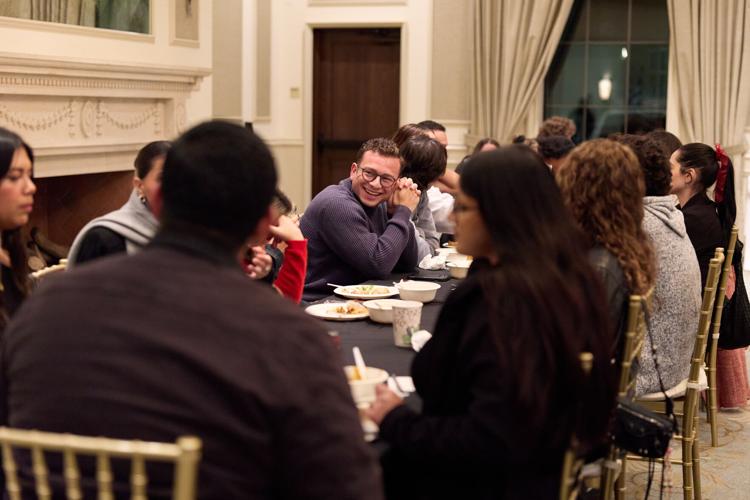
Young, single men are often cited as the driving force behind this trend. But Namee said preliminary data suggest the most recent influx of converts is more diverse, with many Black and Hispanic people, women and young families joining. Clergy report people coming from a host of religious backgrounds, from Islam to witchcraft, as well as different Christian traditions.
Blom’s Holy Theophany launched a second church this year because their 250-capacity building was consistently overflowing, with dozens standing outside each week.
“It’s almost full already,” he said of the new location. “And back at our church, again we have a bunch of people standing outside every Sunday. We just can’t keep up.”
They’re already in talks to launch a third church.
Digital evangelism
While some Orthodox content creators are priests, others have no formal ties to the church. They span ideological and political affiliations, with some leaning far right and others who are conventional religious conservatives on issues like marriage and abortion.
“By and large, Orthodox Christians are not far right. It’s a minority group within a minority religious tradition,” said Sarah Riccardi-Swartz, who studies religion and politics at Northeastern University.
Jonathan Pageau, a Canadian icon carver who teaches symbolism courses online, is among the most popular content creators with about 275,000 YouTube subscribers.
“We have to see it as a kind of irony and something of a paradox. In some ways, you could say we’re using tools that aren’t completely appropriate,” he said of how the internet contrasts with Orthodoxy’s emphasis on in-person liturgy. “At the same time, one of the things that the internet offers is reach. And one of the things Orthodoxy hasn’t had in forever is reach.”
Pageau, who converted in 2003, says he and other influencers stress the importance of in-person community to their followers.
“We tell them to go to church,” he said. “You can’t live this in your mind online because it is distorting. When you go to church, you meet all kinds of people, people that are on all sides of the political aisle.”
From screen to sanctuary
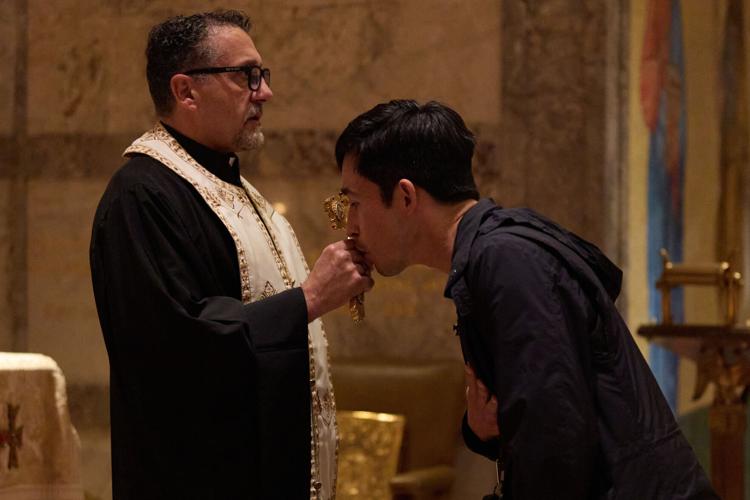
Abia Ailleen researched Orthodoxy online for six months before stepping inside Saint Sophia Greek Orthodox Cathedral in Los Angeles. The 28-year-old Latina, who was chrismated — or received into the faith — in April 2024, also sees a disconnect between Orthodoxy online and in the flesh.
“People who come to Saint Sophia who are very rigid, who want to be perfect and holy based on what they’ve learned on the internet, a lot of the time Saint Sophia isn’t a place that they want to stay,” she said. “We really have cultivated a structure of humility, of making mistakes and of vulnerability.”
To be sure, devout Orthodox do follow a robust program of prayer, fasting and other disciplines. Justin Braxton, a firefighter who converted a year and a half ago, likens some of Orthodoxy's “strenuous” demands to exercise.
“I dreaded leg day, but I would feel amazing afterwards. I feel like that’s the difference between happiness and joy. Happiness is when you’re basically fulfilling carnal needs,” he said. “Joy is that feeling after that tough workout and saying, ‘Yeah, I did it.’”
At the same time, priests often try to temper the yearnings of some converts for rules and structure.
“They come to Orthodoxy and they find that yes, we have rules and we have structure. But within those rules and structure there’s a lot of fluidity,” said the Very Rev. Thomas Zain, dean of St. Nicholas Cathedral in Brooklyn, New York, and vicar general of the Antiochian Orthodox Christian Archdiocese of North America.
His church has seen an exponential increase in attendance, which began about two years ago. “I’ll get like 50 people at a Bible study or adult education class, where I used to get three or four or five,” he said.
Zain, a descendant of Syrian immigrants who was born into the faith, is navigating the ideological diversity from which people are joining. “It’s breathed new life into the church, but it’s also challenging because you’re trying to mold them into one community with the old and the new,” he said.
Orthodoxy and masculinity
Part of what’s fueling the perception that only men are converting is that many influencers overlap with the so-called manosphere — content online that caters toward men grappling with their understanding of masculinity. Orthodoxy is often billed as an alternative or supplement to self-help advice for young men.
“As a theologian, the idea that somehow masculinity — this particular way of thinking about masculinity — is inherent to Orthodox theology and teaching is I think just completely wrong,” said Aristotle Papanikolaou, cofounding director of the Orthodox Christian Studies Center at Fordham University. “There’s actually no logic to the idea that somehow I need to be masculine in this particular way in order to unite myself with God.”
Though appealing to some, others believe these influencers distort their idea of Christianity. “It’s just not my cup of tea,” said Aaron Velasco, a 26-year-old filmmaker chrismated last year.
And while Velasco did take an interest in some content creators, and appreciates Pageau’s demeanor and perspective, he thinks many of them preach an inflammatory version of the faith that doesn’t fit his current understanding of it.
Many adherents say the broader church is more ideologically diverse than the rigid conservatism often found online.
“Look at the institutional church. There is this huge hierarchy where women are not present. It’s hard to say that’s not a masculine image,” said Dina Zingaro, who is studying Orthodoxy at Harvard Divinity School and who was raised in the faith. “At the same time, there are so many counter-narratives in Orthodoxy that uproot this idea.”
The church’s response
Church leaders have made few public responses, however some clergy are beginning to speak more about the magnitude of this influx and its accompanying challenges.
“There are cases of extremism and fundamentalism,” said Metropolitan Saba, leader of the Antiochian Orthodox Christian Archdiocese of North America, during an address last month in Denver. “Many who are coming to the church today are psychologically, emotionally or socially wounded, which requires experienced and mature spiritual fathers and mothers.”
Zingaro, who preaches regularly and teaches courses for Orthodox women on preaching, hopes church leadership will be more vocal.
“Our response in my mind has not been strong enough,” Zingaro said. “There’s something that we’re doing that is making people think it’s OK to make these claims about Orthodoxy. We need to lift up the real spirit and the core of Orthodoxy, which is really the opposite of this rule-based male domination version.”
Associated Press religion coverage receives support through the AP’s collaboration with The Conversation US, with funding from Lilly Endowment Inc. The AP is solely responsible for this content.