



Human rights advocates asked a United Nations panel to intervene Wednesday to help end a new U.S. government practice of withholding from families and lawyers the whereabouts of thousands of detainees facing deportation.
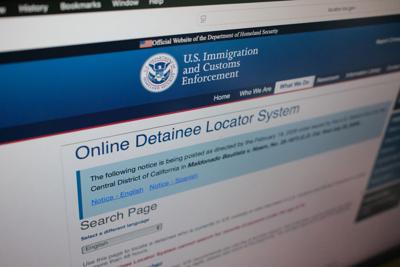
U.S. Immigration and Customs Enforcement removed the names of detainees with final removal orders from its Online Detainee Locator System on Sept. 15 in an apparent effort to speed up their deportations. The change, which ICE did not announce and has not explained, applies to more than 16,000 of the nearly 69,000 detainees who are in ICE custody.
The move has interfered with detainees' ability to challenge looming deportations by impeding access to their lawyers while devastating families who lost track of their loved ones, immigration lawyers say.
A coalition of more than 30 groups who advocate for noncitizens in the U.S. petitioned the U.N.’s Working Group on Enforced or Involuntary Disappearances to declare the policy a violation of international law and to push for its end.
“A system with no transparency is a system with no accountability, and that should terrify all of us,” said Sarah Decker, an attorney at the Robert & Ethel Kennedy Human Rights Center, one of the petition's signatories. “Disappearing people into a network of remote detention sites, hiding their whereabouts, and cutting off their access to outside help is the definition of an enforced disappearance."
Separately, on Wednesday, more than 45 House Democrats led by Reps. Luz Rivas and Veronica Escobar urged ICE to restore the names to the locator, calling the practice of concealing them “contrary to foundational principles of the American legal system.”
ICE's parent agency denied Wednesday that its practices amount to disappearing people, saying all detainees “have opportunities to communicate with their family members and lawyers.”
“The appropriate process due to an illegal alien with final deportation orders is removal, plain and simple,” the Department of Homeland Security said in a statement. “That said, DHS has a stringent law enforcement assessment in place that abides by due process under the U.S. Constitution.”
Detainees can typically call relatives if they have money in their commissary accounts, while calls to their legal representatives are supposed to be free.
Approximately 1.4 million people living in the U.S. are subject to final orders of removal. That typically means an immigration judge has ruled they should be deported and the decision has been upheld on appeal or not appealed. They still have several legal options to challenge their detention and deportation. Federal judges have ruled thousands of times that detainees should be released or granted bond hearings.
The petition to the U.N. said the policy has already “obstructed legal counsel from accessing their clients in detention, preventing interventions to seek immigration relief, challenge unconstitutional detention, and block unlawful deportations.”
It cited examples of several detainees, including a mother and 7-year-old daughter who were challenging their detention at a Texas facility but lost access to their lawyers as they faced deportation to Venezuela. Only after a judge ordered ICE to disclose their whereabouts did the agency do so, about 18 hours later, and release them from custody, the petition said.
One man reported intense stress and that the “darkest thoughts imaginable went through" his mind after the whereabouts of his elderly disabled mother were abruptly removed from the system, according to the petition.
The petition said ICE's online locator, launched in 2010, has become “an even more crucial tool” as President Donald Trump's administration has carried out a sweeping campaign to arrest and deport people who are in the country illegally. It noted that the U.N. working group had lobbied for the locator’s creation and its 2024 expansion to include people detained by the Border Patrol.
The petition asked the U.N. group to urge ICE to publicly list all detainees’ locations within an hour of their arrest and give detainees’ lawyers 24 hours’ notice before a transfer. The U.N. group, which was formed in 1980, helps families locate loved ones who have reportedly been subjected to enforced disappearance by government agents. It has five members and is currently chaired by Grazyna Baranowska of Poland.
