







OCEAN CITY, Md. — Ocean City officials have approved a major technology upgrade for the Ocean City Police Department, including the use of artificial intelligence, in an effort to improve efficiency, officer safety and public service.
Police Chief Raymond Austin said much of the department’s current technology is failing, including in-car camera systems. At one point, the department had 19 operational vehicle cameras, but that number has dropped to nine, with remaining units continuing to break down. The upgrade plan includes the replacement of those systems with 25 new in-car cameras equipped with automatic license plate recognition.

One of the most significant additions is Axon AI, a system police say has already shown promising results.
One of the most significant additions is Axon AI, a system police say has already shown promising results. During a three-month trial, 12 officers used the technology for report writing, resulting in a 58 percent reduction in the time it took to complete reports, according to the department. The system also includes live language translation, currently supporting 57 languages, allowing officers to better communicate with non-English speakers in the field.
“I think any kind of technology that helps our police officers is a plus,” said Ocean City homeowner Frank Howard. “That’s one of the reasons why we like it down here. We feel it’s pretty safe, but it can always be better.”
Austin said reducing time spent on paperwork allows officers to spend more time patrolling neighborhoods and responding to calls.

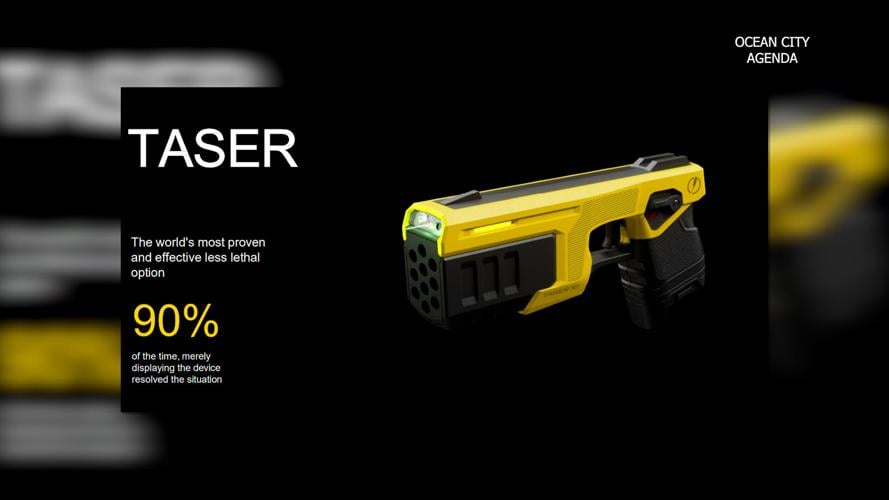
The technology overhaul also includes new Tasers.
The technology overhaul also includes new Tasers. The department plans to replace its current models with Taser 10 devices, which have a range of 45 feet, compared to the existing 25-foot range. The new devices feature advanced probes designed to penetrate thicker clothing during winter months while using less voltage.
Additional upgrades include new body-worn cameras, a drone detection system capable of identifying the location of unauthorized drone operators, and a real-time crime center known as Fusus. The system allows officers to access live video feeds and streams from multiple sources to assist with active investigations.
The total cost of the technology package is expected to be nearly $5 million over the course of a five-year contract.
