



The United States captured Venezuelan President Nicolás Maduro and flew him out of the country in an extraordinary nighttime operation that was accompanied by a flurry of strikes following months of escalating Trump administration pressure on the oil-rich South American nation. The U.S. is now deciding next steps for Venezuela, President Donald Trump said Saturday on Fox News, adding, “We’ll be involved in it very much.”
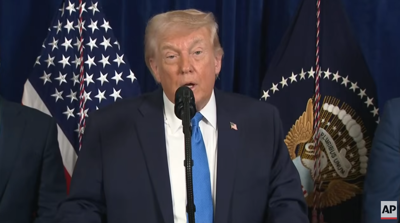
Nearly 40 minutes after its scheduled 11 a.m. ET start time, Trump’s press conference is underway. Accompanying the U.S. president are Pete Hegseth, the Pentagon chief; Secretary of State Marco Rubio, CIA Director John Ratcliffe, and Stephen Miller, a top White House aide overseeing homeland security matters.
Trump says the US is ‘going to run’ Venezuela until a safe transition of power can take place. However, there are no visible signs yet that the US is running Venezuela after Trump claims, as country’s security forces control key sites.
Trump did say that Rubio has spoken to the Venezuelan Vice President to make that country ‘great again.' There has been no word from the Venezuelan government.
The president said the operation carried out by U.S. forces was an “assault like people have not seen since World War II” and that no other nation “could achieve what America achieved yesterday.”
“This was one of the most stunning, effective and powerful displays of American military might and competence in American history,” Trump said.
The president brought up the 1823 Monroe Doctrine, formulated by President James Monroe, which was used to justify U.S. military interventions in Latin America. Trump added his name to it, calling it “The Don-Roe Doctrine” and said, “American dominance in the Western Hemisphere will never be questioned again.”
Trump has repeatedly claimed without evidence that boats have been carrying drugs into the U.S. from Venezuela. But in fact Venezuela is not a major source of drugs. There is no evidence to suggest fentanyl comes from Venezuela. Rather, the vast majority of fentanyl that flows into the U.S. is transported in through Mexico, and often produced from precursor chemicals coming from Asia. While a number of illegal armed groups are present in Venezuela, much of the cocaine flowing out from Venezuela is produced in Colombia and other Andean nations. The Caribbean is often used as a jumping off point for drug traffickers to smuggle their product to European markets.
The defense secretary likened the attack on Venezuela to the U.S. strikes on Iran last summer over that country’s nuclear program, saying that, “Maduro had his chance, just like Iran had their chance.”
He said adversaries of the U.S. should “remain on notice” that “America can project our will anywhere, anytime.”
“Welcome to 2026, and under President Trump, America is back,” he said.
The US general says that the Venezuela operation planning began months ago with intelligence officials tracking Maduro’s movements.
No airline flights were crossing over Venezuela Saturday, according to FlightRadar24.com. And major airlines canceled hundreds of flights across the eastern Caribbean after the FAA imposed restrictions and warned passengers that the disruptions could continue for days.
Flights to Puerto Rico, the Virgin Islands, Aruba and other destinations in the region near Venezuela were cancelled. The airlines are waiving change fees for passengers who have to reschedule their flights this weekend.
Gen. Dan Caine, the chairman of the Joint Chiefs of Staff, detailed a “meticulously planned” operation that he said had been months in the making, crafted to minimize harm both to Maduro and his wife, as well as civilians. Through the holiday weeks of Christmas and New Year’s, Caine said service members watched and “sat ready” for the order, which the general said could come only once weather conditions improved Friday night.
“Last night the weather broke just enough, clearing a path that only the most skilled aviators in the world could move through,” Caine said, noting that helicopters flew low to the water to enter Venezuela, covered above by protective U.S. aircraft.
The chairman of the Joint Chiefs of Staff said that the helicopters took fire as they closed in on Maduro’s compound. One of the helicopters was struck by fire but remained flyable, John Caine said. He added that all of the aircraft came home.
Gen. Dan Caine, the president’s top military advisor, said that more than 150 aircraft from 20 different bases were involved in the surprise, overnight attack on Venezuela that captured President Nicolas Maduro.
Caine said the aircraft included F-22, F-35, and F-18 fighter jets as well as B1 bombers and other support aircraft “as well as numerous remotely piloted drones.”
Caine said that the mission of the aircraft was to provide cover for the helicopters that acted as the “extraction force” with the goal of capturing Maduro and his wife.
“There were multiple self-defense engagements as the force began to withdraw out of Venezuela,” Caine said. He also said that the military chose “the right day to minimize the potential for civilian harm and maximize the element of surprise.”
Trump says the US will tap Venezuela’s vast oil reserves and sell ‘large amounts’ to other countries after Maduro ouster. U.S. Attorney General Pam Bondi said Maduro and his wife would face charges after an indictment in New York. Bondi vowed in a social media post that the couple would “soon face the full wrath of American justice on American soil in American courts.”
The stunning American military action, which plucked a nation’s sitting leader from office, echoed the U.S. invasion of Panama that led to the surrender and seizure of its leader, Manuel Antonio Noriega, in 1990 — exactly 36 years ago Saturday.
