



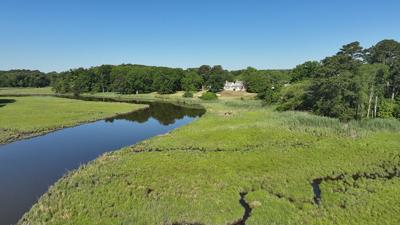

WICOMICO COUNTY, Md. — The Maryland Department of Natural Resources celebrated the acquisition of the 445-acre Wetipquin Creek State Park property on Tuesday, giving local leaders and invited guests a preview of what will become Wicomico County's first state park.
The Maryland Park Service named the new park after Wetipquin Creek, which flows through the property before emptying into the Nanticoke River.
Currently in the planning phase, Wetipquin Creek State Park is intended to conserve the natural resources of the Delmarva Peninsula while highlighting the region's history. The property includes Long Hill, a historic home dating to the mid-18th century that was added to the National Register of Historic Places in 1974.
"Places like Wetipquin Creek State Park remind us that conservation is about more than protecting land. It is about protecting memory, culture, and opportunity for future generations," Maryland Department of Natural Resources Secretary Josh Kurtz said. "This bucolic and historic site will conserve and foster an appreciation of the natural resources and history of Maryland's lower Eastern Shore."
The Maryland Park Service plans to offer interpretive and educational programs, tours and events focused on the property's history, including Long Hill, the lives of enslaved people who lived and worked there, the history of Indigenous communities in the region, and 18th- and 19th-century farm life on the Eastern Shore.
"Maryland State Parks are managed to reflect the natural and historic character of the communities they represent for the enjoyment of our people who live there and visitors," Maryland Park Service Director Ranger Angela Crenshaw said. "That's what we will provide here at Wetipquin Creek State Park."
Once the park opens, every county in Maryland will have at least one state park.
The department received approval to purchase the property in 2024 and completed the $3.3 million acquisition earlier this year. Former owner Donald Graham attended Tuesday's event and spoke about the property's history.
Long Hill has strong historical ties to the Dashiell family, whose members played prominent roles in colonial Maryland. Graham, a descendant of the Dashiell family, purchased the property because of its historical and personal significance. His family preserved the home's historic features and protected its environmental resources, including placing the land under a conservation easement through the Maryland Environmental Trust in 2016.
The property's history also includes the lives of enslaved African Americans who labored at Long Hill. Descendants of those enslaved workers attended Tuesday's celebration. State officials said future exhibits and interpretive signs will tell their stories and present the history of American slavery.
Dr. Bryant Mitchell of the University of Maryland Eastern Shore and Emmett Dashiell, a descendant of enslaved workers at Long Hill, also addressed attendees on behalf of the Wetipquin community.
The park will also highlight the history of Indigenous people connected to the land. Representatives of the Pocomoke Indian Nation and the Nause-Waiwash Band of Indians participated in the event. The Nause-Waiwash Band traces its ancestry to two Nanticoke villages encountered by English explorer John Smith in the early 1600s.
"Places like Wetipquin Creek State Park help us honor those that came before us and see more clearly who we are and where we have come from," said Chichi Nyagah-Nash, deputy chief of staff to Gov. Wes Moore. "They remind us that the story of Maryland, and the story of America, is only complete when we tell the truth about the people who built this nation, sustained its communities, cared for its landscapes, and expanded our understanding of freedom and belonging. Wetipquin Creek State Park does this and today we're making a promise to carry this legacy forward."
The Maryland Park Service said the new park is part of a broader effort to expand public access to parks and preserve sites that tell important stories about the state's history as the nation approaches the 250th anniversary of its independence.
Earlier this year, the Park Service added a historic African American cemetery at Catoctin Furnace to Cunningham Falls State Park and dedicated Freedman's State Park in Montgomery County, preserving land once owned and farmed by a formerly enslaved family whose descendants helped shape Maryland's Civil Rights Movement.
