




DOVER, Del. — Delaware is taking a major step to protect its forests with the launch of a $1.5 million Forest Resiliency Fund, the largest grant in Delaware Forest Service history aimed at supporting landowners in boosting forest health.
The Delaware Forest Service received the funding from the U.S. Forest Service through the Inflation Reduction Act of 2022. The money will be used to create a cost-share program for landowners looking to plant trees, remove invasive species, or implement prescribed fire as part of their forest management plans.
“This is by far the largest amount of grant funding in history that the Delaware Forest Service has received to promote forest stewardship to help improve forest conditions throughout the state,” said Kyle Hoyd, Delaware State Forester. “We are excited to be able to implement the Delaware Forest Resiliency Fund to expand upon the efforts of our existing cost-share programs.”
The program is open to non-industrial private forestland owners, homeowners associations, nonprofits, municipalities, and county governments. Each project must cover at least three acres, and landowners must not own more than 10,000 forested acres in Delaware. Applications are reviewed on a rolling, first-come, first-served basis, subject to funding availability.
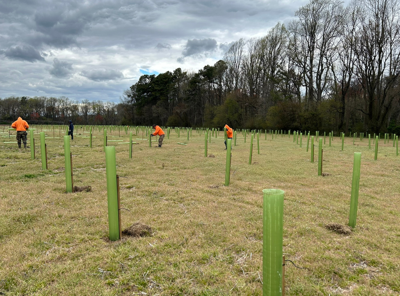
Delaware has been facing widespread forest loss due to factors like high-graded hardwood stands and monoculture pine forests. By promoting tree planting with native species—including oak, shortleaf pine, Atlantic white cedar, bald cypress, and pitch pine—the state hopes to reverse the trend of net canopy loss within five years.
“Along with tree planting, we also selected invasive species control and prescribed fire as practices that would help improve forest health and resiliency, not only for participating landowners but all Delawareans,” said Forest Stewardship Coordinator Laura Upham.
Invasive species are a major concern, often displacing native plants and reducing habitat for wildlife. Eligible plants for removal must be classified as invasive by the Delaware Invasive Species Council and located in forested areas, as defined by the U.S. Forest Service.
Prescribed fire, another key component of the fund, can help restore native species that rely on fire for regeneration while removing invasives that thrive in fire-free environments. Eligible landowners can use funds to install vegetative fire breaks, create burn plans, and carry out safe prescribed fires.
There is no maximum funding limit for tree planting projects. However, invasive species and prescribed fire efforts are capped at $10,000 per landowner. Payments for planting projects will go directly to suppliers and contractors, while reimbursement will be issued for invasive species removal and prescribed fire projects upon verification.
To learn more or apply, visit the website here.
