



WASHINGTON (AP) — A lawyer for the suspected organizer of a deadly al-Qaida attack on a U.S. warship in the year 2000 wants a military court to determine his competence before trial, arguing that he has a traumatic brain injury “arising from torture in CIA custody.”
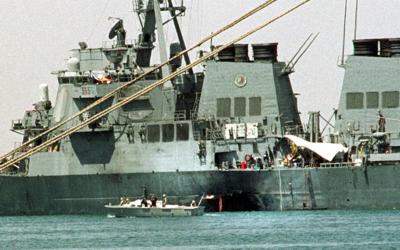
A trial is scheduled to start this month for Abd al-Rahim al-Nashiri in the killing of 17 U.S. sailors, who died when an explosives-laden skiff blew up alongside the USS Cole destroyer off the coast of Yemen. He faces a possible death penalty. The proceedings at a U.S. Navy base in Cuba, where he is detained, could last up to five weeks.
Captured in 2002, Nashiri underwent waterboarding, beatings, and confinement in a crate for years in CIA custody at clandestine detention facilities. Declassified documents released in 2018 graphically described how he was stripped naked, repeatedly slammed against walls and left “moaning, shaking and asking God to help him repeatedly.”
Nashiri's attorney, Allison Ferber Miller, asked a federal court in Washington, D.C., on Thursday to delay the proceedings until the military commission has had enough time to determine his mental capacity.
A psychiatrist for the defense who examined Nashiri in August concluded that he is “not competent,” Miller wrote.
“He diagnosed a traumatic brain injury (TBI) arising from torture in CIA custody, a severe neurocognitive disorder, complex post-traumatic stress disorder (PTSD), and major depression,” Miller wrote. “He concluded that Petitioner cannot understand the proceedings or assist his counsel.”
Miller wrote that Nashiri is not asking the federal judge to determine his competence but to delay the trial until the military commission has had “a meaningful opportunity” to do so.
The military judge had ordered a competency evaluation, “but left no time for a meaningful hearing” on whether al-Nashiri is fit for trial, Miller wrote, adding that the military judge has declined three times to stay the proceedings until the question of Nashiri's competence was resolved.
Lawyers in the case were scheduled to travel to Guantanamo Bay on Saturday, Miller wrote. The military judge left open the possibility for a competency hearing on Monday morning, the same day the trial was scheduled to begin.
The trial has since been rescheduled to start a week later on Oct. 26, according to Ronald Flesvig, the spokesman for the Office of Military Commissions at Guantanamo Bay.
The Office of the Chief Prosecutor for military commissions at Guantanamo Bay did not immediately respond to an email requesting comment.
Proceedings before the military commission were previously mired in delays and in legal challenges over admissibility of evidence from the torture-aided interrogations of Nashiri and over other circumstances of his trial and detention. Questions over the handling of Nashiri’s case, like those of other Guantanamo Bay detainees accused of planning and aiding al-Qaida’s 9/11 attacks on the United States, have led to constitutional debates and other problems.
