



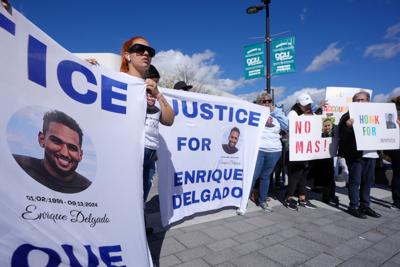
WORCESTER, Mass. (AP) — A supervisor and two instructors with a Massachusetts State Police tactical unit were arraigned Thursday in connection with the death of a recruit who suffered a concussion during a sparring session and several blunt force injuries a day later in what investigators described as an “unapproved and unsafe” boxing match.
Enrique Delgado-Garcia, 25, died at a hospital on Sept. 13, 2024, a day after becoming unresponsive during a defensive tactics exercise in a boxing ring and undergoing a “medical crisis,” authorities said at the time. Charges in these types of cases are exceedingly rare.
David Meier, who was appointed by the Massachusetts attorney general to investigate the death, said in February that the supervisor and the instructors in the police academy’s defensive tactics unit are charged with involuntary manslaughter and causing serious bodily injury to a person participating in a training program. The supervisor has been charged with perjury in connection with her grand jury testimony.
All three defendants entered not guilty pleas on all charges before Worcester Superior Court Judge J. Gavin Reardon Jr.
Meier said unsafe sparring sessions led to Delgado-Garcia's concussion. A day later, the investigator said, the trainee sustained “multiple blunt force injuries to the head and massive brain bleeding” after academy staff failed to stop a training boxing match.
Lt. Jennifer Penton, the supervisor and a sergeant at the time she was charged, along with Troopers Edwin Rodriguez and David Montanez, were arraigned in Worcester Superior Court on Thursday. A fourth trooper, Casey LaMonte, will be arraigned on April 14.
When the charges were announced in February, Brian Williams, the president of the State Police Association of Massachusetts, said “the veteran training staff indicted today are entitled to the same presumption of innocence and due process guaranteed to every citizen.”
The association stands behind its members and will vigorously defend them while working with the department to improve training standards, he said in a statement.
Massachusetts Attorney General Andrea Campbell told reporters in February that it was important that an independent, impartial investigation be conducted. It follows calls from several advocacy groups and Delgado-Garcia’s family and friends for those responsible for his death to be held accountable.
“The family is relieved there has been progress in the case from the beginning,” their attorney, Mike Wilcox, said at the time, adding that there was “light at the end of the tunnel in terms of accountability.”
A string of tragedies across the nation in recent years has brought new attention to the details of curricula at law enforcement academies.
An Associated Press investigation, “ Dying to Serve, ” has found that more than 30 recruits have died during law enforcement academies since 2015, caused by a mix of violent or grueling training exercises, heat, exertion and other medical conditions.
The number of deaths have risen in recent years as departments turn to less-traditional candidates to fill openings but maintain longstanding academy drills. Investigators have generally treated them as unfortunate but unavoidable medical incidents, and criminal charges have usually not been considered.
The charges in Massachusetts are believed to be the first related to a police academy recruit’s death in years. In examining the deaths of 37 recruits since 2005, AP could not find any other case that led to criminal charges.
Other forms of legal accountability, including civil lawsuits and workplace safety investigations, have also rarely been pursued. Families have struggled to collect federal death benefits, even after Congress passed a law clarifying that recruits were eligible.
Last month, the family of San Francisco police recruit Jon-Marques Psalms, who died after collapsing during a combat training exercise in August 2025, filed a wrongful death lawsuit against the department alleging negligence. The city attorney’s office issued a statement that its “thoughts and prayers” were with the family after Psalms' “tragic” death and that it was reviewing the complaint and would respond in court.
Associated Press writer Ryan J. Foley in Iowa City, Iowa, contributed to this report.