



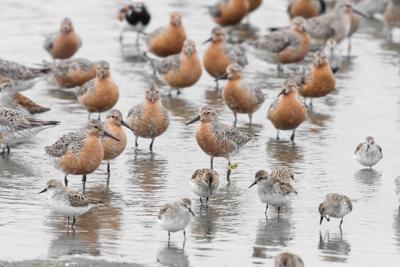

SLAUGHTER BEACH, Del. — Thousands of red knots returned to Mispillion Harbor near Slaughter Beach this spring, giving Delaware one of its strongest migration seasons in recent years despite a delayed horseshoe crab spawning season, according to the Delaware Department of Natural Resources and Environmental Control.
The Delaware Shorebird Project counted nearly 2,000 red knots at Mispillion Harbor on May 11, with numbers climbing to about 3,000 by May 20. Unlike recent years, the birds stayed in Delaware throughout the migration stopover instead of concentrating mainly in New Jersey, according to DNREC.
Researchers also found the birds were in excellent condition. Weight data collected from 377 red knots between May 10 and May 30 showed many birds reached or exceeded historical averages, with several topping the estimated 180-gram departure weight needed to continue their migration, DNREC said.
A colder-than-average spring delayed horseshoe crab spawning across Delaware Bay, but Mispillion Harbor warmed earlier than many nearby areas, providing one of the first reliable food sources for migrating shorebirds, according to DNREC.
“These findings indicate that complex factors such as migration timing, habitat conditions, animal behavior, and the availability of suitable feeding and roosting areas interact with overall horseshoe crab abundance in determining where red knots concentrate each spring,” said Delaware Shorebird Project leader and DNREC Coastal Waterbird Biologist Kat Christie. “While horseshoe crab spawning density in Mispillion Harbor was not noticeably different this year than years where red knots were largely absent from the shorebird flocks there, the red knot response to it was like night and day.”
During the 2026 season, researchers flagged 343 red knots and recorded nearly 4,000 sightings of flagged birds. The project also tracked hundreds of other migrating shorebirds as part of ongoing research into improving habitat throughout Delaware Bay, DNREC said.
