



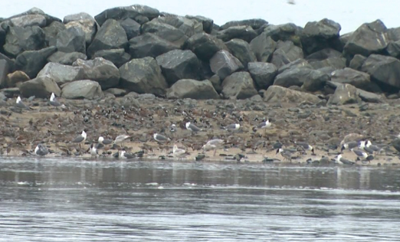

SLAUGHTER BEACH, Del. - Thousands of shorebirds are making their annual stop along the Delaware Bay as they migrate from South America to the Arctic for breeding season.
Every spring, the birds arrive along the Delaware coast to rest and refuel during a period known as a stopover, when shorebirds build up energy before continuing their journey north.
“This is one of the coolest places to be this time of year for anyone who loves birds or just loves seeing a natural phenomenon,” said Kat Christie, coastal waterbird biologist with the Delaware Department of Natural Resources and Environmental Control.
Christie said the birds travel thousands of miles, with some coming from as far south as Argentina before reaching the Delaware Bay around the same time each year.
“It amazes me every time that they even find areas like this again,” Christie said. “With the range they are traveling, they are often coming from the Caribbean and South America, sometimes as far south as the tip of Argentina, and they get here at about the same time every year.”
To monitor the migration, DNREC conducts aerial surveys across the Delaware coast, beginning over New Jersey and continuing into Delaware. Officials use the flights to conduct peak counts during what they hope is the busiest period for both horseshoe crab spawning and shorebird feeding activity.
From above, large groups of birds gathered along the shoreline can resemble dark patches of mud. As the survey plane approaches, the flocks often lift off together in large groups.
“It is just a cloud of birds that all kind of lifts up at once,” Christie said.
Christie said DNREC tries to minimize disturbances to the birds so they can conserve energy for the next stage of their migration. The aerial survey is one of the few times officials closely approach the flocks, and visitors are encouraged to keep their distance as well.
