



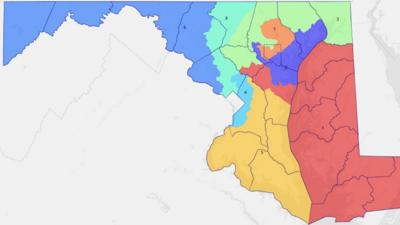
MARYLAND - An Anne Arundel Circuit Court Judge blocked the Maryland State Board of Elections on Wednesday from placing a redistricting question on the ballot in November, though the Maryland Supreme Court will now have to consider the case.
According to a Memorandum Opinion issued on Wednesday, Aug. 26 and acquired by WBOC, the Anne Arundel Circuit Court judge found both the process used to advance the measure and its wording “legally deficient.”
However, Judge Robert J. Thompson stayed his injunction while the state pursues an immediate appeal to the Supreme Court of Maryland, meaning the ruling does not immediately remove the question from the ballot.
The decision concerns statewide Ballot Question 3 which originated with House Bill 2100, passed by the Maryland General Assembly during a special session earlier this month.
Proposed Constitutional Amendment
According to the court opinion, HB 2100 would amend the Maryland Constitution to specify that certain requirements for legislative districts apply to districts used to elect members of the General Assembly. The proposal would also allow the General Assembly to give the Supreme Court of Maryland jurisdiction to review congressional districting plans, and provide that the Maryland Constitution does not establish criteria for congressional district boundaries.
The proposed redistricting would put Republican Congressman Andy Harris’ seat in jeopardy.
Gov. Wes Moore called the General Assembly into a special session beginning Aug. 3 for the stated purpose of passing legislation to amend the state constitution concerning congressional districts. HB 2100 was introduced Aug. 3 and passed both chambers Aug. 4.
As WBOC previously reported, Maryland Republicans swiftly sued to block the bill.
Court finds process deficient
Central to the lawsuit is Senate Bill 29, legislation enacted earlier this year that changed requirements and deadlines for statewide ballot questions.
Among those provisions is a requirement for the Secretary of State to prepare and certify required information for statewide ballot questions to the State Board of Elections by July 1 before a general election. The law also provides for a 15-day public comment period and requires certain information about proposed constitutional amendments to be widely accessible at least 90 days before an election.
HB 2100 was not introduced until Aug. 3, more than a month after that July 1 deadline.
Plaintiffs Michael L. Howell and others filed suit Aug. 6 seeking to prevent the Maryland State Board of Elections from placing Question 3 on the Nov. 3 ballot, arguing the state failed to comply with the requirements established under SB 29.
The state argued, according to the opinion, that those requirements did not apply because the General Assembly itself drafted the ballot question rather than delegating that responsibility to the Secretary of State.
Judge Thompson disagreed.
"Because the legislature did not follow the very laws it enacted, the court finds the enactment of HB2100 to be legally deficient," Thompson wrote.
Judge calls ballot language misleading
The court also took issue with how Question 3 is worded.
The ballot question says the proposed amendment "clarifies" that certain standards in the Maryland Constitution apply only to districts used to elect members of the General Assembly.
Thompson found the use of the word "clarifies" misleading.
The opinion points to an earlier Maryland court decision, Szeliga v. Lamone, which Thompson said established that the state's constitutional districting requirements apply to both state legislative and congressional districts.
"The status quo in Maryland is that the legislative districting requirements in the state Constitution applies to both state and federal legislative districts," Thompson wrote.
He concluded the word "clarifies" is "intentionally misleading" and said that alone should disqualify the question as currently written.
Court says question combines separate issues
Thompson identified another problem with the proposal, finding it combines more than one issue into a single ballot question.
In addition to changing how constitutional districting requirements apply to congressional districts, the proposal would allow the General Assembly to grant the Supreme Court of Maryland original jurisdiction over congressional redistricting cases.
The judge wrote that Maryland's Constitution requires a referred question to concern a single issue and concluded those two provisions are separate matters.
"The court finds that the process used by the General Assembly to propose ballot Question 3 was deficient," Thompson wrote. "Further, in the General Assembly's rush to pass the measure in a hastily called special session, the presumptions and thus the wording of the question itself are deficient."
Maryland Supreme Court to weigh in
Thompson ruled that the State Board of Elections should be barred from including Question 3 on the Nov. 3 general election ballot, but immediately stayed that injunction pending an appeal to the Supreme Court of Maryland.
Thompson wrote that the stay would preserve the state's ability to present a ballot while the appeal proceeds. The dispute now moves toward Maryland's highest court.
