



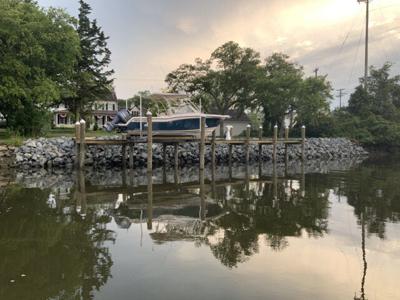

DELAWARE — A new Delaware law is designed to speed up permits for docks, utility lines and other projects involving the state’s submerged lands and tidal waters.
Gov. Matt Meyer signed House Bill 456 last week, updating Delaware’s Subaqueous Lands Act and establishing new timelines for permit decisions by the Delaware Department of Natural Resources and Environmental Control.
The law applies to projects involving riverbeds, lake bottoms, streams and tidal lands. It was sponsored by Rep. Cyndie Romer, Rep. Ronald Gray and Sen. Kyra Hoffner as part of efforts by Meyer and DNREC to streamline environmental permitting.
“We are cutting the time Delawareans can expect for a straightforward dock permit or a utility line crossing, with clear timelines and more certainty for applicants,” Meyer said. “DNREC water permitting staff has been identifying ways to improve, and that’s what effective, responsive government looks like.”
For small private residential docks of no more than 300 square feet, DNREC must tell applicants within 30 days whether an application is administratively complete.
If DNREC has not approved or denied a permit within 120 days after receiving a complete application, the permit will automatically be granted as long as a licensed contractor or consultant certifies the project does not create a public safety or navigation hazard, disturb neighboring riparian rights or unduly restrict public access to submerged lands.
“We’ve made permitting reform a real priority and this bill reflects the work of our expert staff alongside General Assembly members who heard from businesses and property owners about where the system needed to change,” DNREC Secretary Greg Patterson said.
The law also expands the use of general permits for categories of routine, lower-impact work that otherwise could require individual reviews.
Those permits will cover linear utility infrastructure, including water, sewer, stormwater and telecommunications lines; small residential docks; voluntary aquatic habitat restoration projects; minor tidal road crossings; minor bank stabilization; navigational aids and public signage; and certain pilings in nontidal submerged lands.
Beginning Sept. 19, some work on privately owned nontidal submerged lands will also be exempt from a separate state subaqueous review when the work is already covered by a U.S. Army Corps of Engineers Nationwide Permit and has a state Water Quality Certification when required.
DNREC said the change is intended to eliminate duplicate reviews.
House Bill 456 also allows the DNREC secretary to delegate some permitting decisions to department staff. Previously, the secretary had to personally sign every subaqueous lands lease. Staff members can now be authorized to approve leases involving 2,500 square feet or less.
The law also establishes a seven-member Marine Contractors and Consultants Licensing Board. Members will be designated by the DNREC secretary, while DNREC will retain licensing authority and develop regulations governing the program.
Six months after those regulations are finalized, subaqueous permit applications will have to be submitted by an individual or company licensed through the program.
DNREC said the licensing structure was requested by Delaware’s marine contracting industry and is intended to improve application quality and reduce delays caused by incomplete or unclear submissions.
The changes build on other efforts by DNREC’s Division of Water to modernize permitting. The department has launched online dashboards that allow homeowners, contractors and the public to track application status, see their place in a review queue and access issued permit documents.
DNREC has also expanded its Statewide Activity Approval program for certain low-impact projects and created an application tool to help applicants determine which type of permit or authorization they need.
