



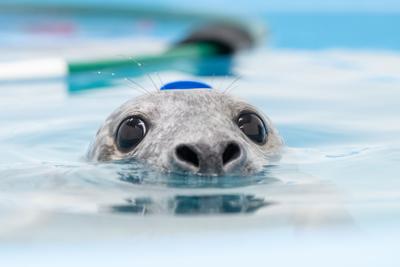

OCEAN CITY, Md. — After a handful of recent rescues, it seems that The National Aquarium’s Animal Rescue team, based out of Ocean City, is in the middle of seal-saving season.
According to the rescue team, this has been the busiest season since 2019, with four seal pups currently getting care at the National Aquarium Animal Care and Rescue Center in Baltimore. In a string of stories that pull at the heartstrings of animal lovers, the seals have all been young pups or what are known as weanlings that have been recently separated from their mothers, or faced malnutrition, dehydration and infection.
As of March 14, the ACRC reached capacity with four seals in rehabilitation. Three of the seals were transported from the Aquarium’s triage center in Ocean City, Maryland, while one was brought directly from the beach. Once those seals reach the rehabilitation facility the Animal Health and Rescue teams work to teach the pups to forage for food and eat independently while also providing fluids, antibiotics, pain management, and round-the-clock care.
Meet the Rescued Seals:
- Woodberry: A male grey seal pup was rescued by the Marine Education, Rescue & Rehabilitation Institute from Fenwick on Feb. 25. Woodberry was malnourished and had infected puncture wounds, possibly from an encounter with a larger animal. He is now eating independently and improving.
- Evergreen: Another male grey seal pup was rescued from Cape Henlopen State Park on March 9. Evergreen sustained puncture wounds that appear to be the result of a shark attack. He is receiving antibiotics and pain medication and remains in “dry dock” while his wounds heal.
- Waverly: A female grey seal was collected from Dewey Beach on March 10. She had infected puncture wounds and a lacerated hind flipper. After stabilizing at the Stranding Response Center in Ocean City, she arrived at the ACRC on March 13 and is now eating independently.
- Arcadia: A maternally dependent female grey seal was found stranded in Ocean City on March 13. She arrived at the ACRC on March 14 in critical condition with an infected puncture wound, eye infection, and oral trauma. Arcadia is receiving antibiotics, fluids, and pain management, but her condition remains unstable.
According to NOAA the jump in seal rescues is likely linked to the establishment of a breeding colony of harbor and grey seals off the coast of Cape Henlopen. Before they can be released each seal must weigh around 25 kg and be free of infections. Once that happens they can be cleared by the National Oceanographic and Atmospheric Administration and returned to the ocean.
