



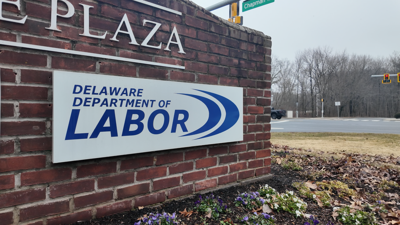


DELAWARE - Employers in Delaware with 10 or more eligible employees must submit required hours and wage reports to the Department of Labor by the end of a 90-day grace period on Tuesday, March 31, in order for workers to receive benefits through the state's Paid Leave program, which began Jan. 1.
The program is funded by contributions from employers and employees, totaling less than one percent of weekly wages. Eligible employees receive 80 percent of their weekly wages, capped at $900 a week.
Requirements of the program include whether the employee has worked for that employer for 12 months and 1,250 hours during that period before their claim.
"The hour and wage report answers both of those questions, and if they're provided, it's a one-moment process, as the computer does the counting and confirms that they've achieved those," Chris Counihan, director of Delaware's Division of Paid Leave, said.
Counihan added that about 6,000 employers in Delaware fit that requirement and noted the reports are quarterly for all of 2025 and are typically due 30 days after the end of each quarter.
"If they haven't provided that information, then there is a manual process that involves phone calls, contacting the right people, and getting the information," Counihan said.
He added that not all employers complied in time.
"The issue, of course, is that the two things that we were told by the other 13 states are don't charge penalties and interest, and don't tell anybody that you're not charging penalties and interest. We actually told, and some employers and payroll companies use that as a reason to delay their submissions," Counihan said.
Counihan said if everything is done properly, a claim can be done in two to three weeks.
In February, payments were temporarily suspended due to a system error with the calculation of the weekly benefits.
"We realized that, we sent out the first batch of checks with manually corrected amounts, but that's not a sustainable method. So, we needed to shut down the system, pause benefits for a moment while we repaired the actual calculation process," Counihan said.
Counihan noted another issue that left some people without access to the system for a couple of days.
"It wasn't the full group of participants in the program, but it was just an issue with the security update that came out from our technology provider," Counihan added.
He said the system was still open to receive claims for health care providers and employers who were working on submitting documentation.
"The heartbreaking part for us is that we know that we're not serving that purpose, that right now, every delay that we have is not helping them with the one thing that we can," Counihan said.
Counihan noted one ongoing issue involves medical documentation.
"The one problem that has not just been with our program, but with all the other 13 states, is receiving the certificate of serious health condition from health care providers. That is definitely a pain point that we're working with the employees and with the health care providers, to ensure it comes in as quickly as possible," Counihan said.
Counihan said the department needs complete information before paying claims.
"The system is working when the information is provided. Without the information, then we might be paying fraudulent claims to those who aren't eligible. We need to have the information to make sure that we are following the rules of the program, because not only do we need to take care of the people who are eligible for the benefits, we also have a duty and a responsibility to ensure that the benefits that we send out are to the right people," Counihan said. "If we send out too many benefits, we will be in a potentially loss position, and the worst outcome would be not the worst, but a bad outcome would be for the fund to not be able to be sufficient to pay out the claims. We would need to, therefore, ask for a rate increase, which we have no intention of actually doing, and that would cause the potential of the entire program going away, because the rates are already something that is divisive in the community, especially in the business community."
He added that the first year of the program is a learning process.
"What we've learned from the other 13 jurisdictions is that for the first year of the program, you really shouldn't charge any penalties or interest because it's a learning process, both for ourselves in the program, but also for the employers, for their payroll companies, for everybody involved as we try to learn together how to make this program work," Counihan said.
Counihan said the department continues to work to issue payments to those eligible.
"The purpose of this program is to help people who are dealing with their own medical issues or their loved ones' medical issues. We can't do anything to make that part of their lives better, but what we can do is supply them with a benefit that will at least let them not worry about their finances," Counihan said.
House Bill 128 establishes a nine-person committee to oversee the program. As of early March, no one had been appointed.
As of March 30, Counihan said they received 3,391 claims. He said they are expecting 23,000 claims a year.
Data provided by the department to CoastTV News shows, as of March 30, 1,681 claims were for medical leave, making up 49.6 percent; 1,184 were for parental leave, or 34.9 percent; 524 were for family caregiving, or 15.5 percent; and two were for qualified exigency, or 0.01 percent. The same data shows 30.7 percent of claims were ineligible, meaning denied; 25.6 percent were pending, meaning they require information from an employer or doctor; 19.3 percent were expired, meaning they are past the return-to-work date; 13.0 percent were incomplete and require additional information from the employee; 7.6 percent were open and verified by the division and being paid; 2.9 percent were exhausted, meaning fully paid out; 0.5 percent were approved and authorized by the employer; and 0.4 percent were filed in error.
A woman reached out to CoastTV News and said that as of the end of February, the Department of Labor was still waiting for her employer to submit the documentation. At the time, she told CoastTV she's "about to lose everything."
Gina Slansky, a Delaware public school teacher, started her maternity leave Jan. 28, the day her first son was born. She is expected to take 12 weeks off and return to work on May 5.
She said signing up was a straightforward process.
"We did it straight through our employer, through the human resources department of our school district," she said. "Our human resources department was so readily available to give us all the answers that we needed, to walk us through the entire process, and to make us feel really comfortable during that process."
She said she is grateful for receiving all the payments with no issues.
"This Delaware Paid Leave Program ensures that we are able to do that and not have to worry about anything financial, that we could just take all of our time and energy and just give it to him right now," she said.
Her husband, Jason, also a Delaware public school teacher, started paternity leave on March 13.
"It's amazing the chance to be home and raise our son, and be able to still have our income, and not have to worry about how we're going to feed him or pay any bills. It's been an amazing experience," he said.
Counihan told CoastTV News that if by Tuesday there is any missing information, employers will be charged with all of the penalties going back to 2025 when the information was due. He also said that by the end of the fall, all the necessary parts of the program, like employer and doctor paperwork, should be refined.
