



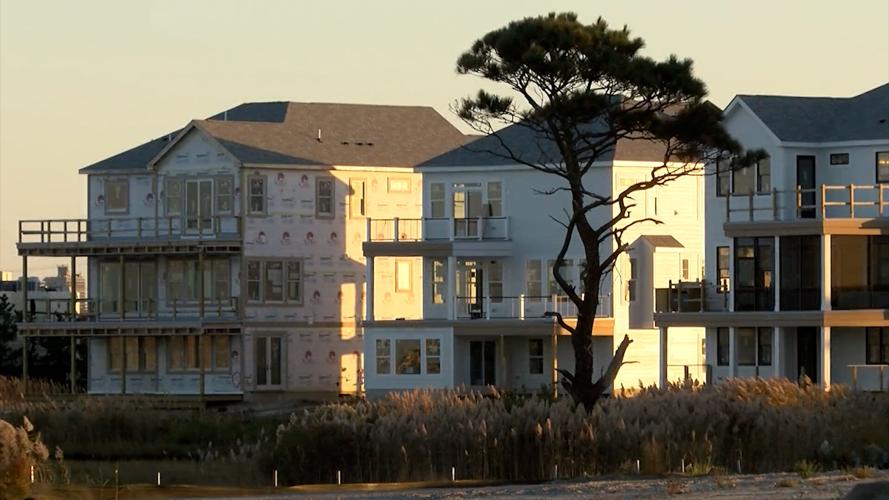


GEORGETOWN, Del. - Sussex County’s explosive growth has transformed farmland into neighborhoods and back roads into traffic chokepoints, pushing land use laws written decades ago into the spotlight and sparking debate over what is working, and what is not.
The county is the fastest-growing in Delaware, with roughly 4,000 new people moving in each year. U.S. Census data shows Sussex County’s population grew by more than 14 percent from April 2020 to July 2024, a surge accelerated by people leaving crowded cities during the COVID-19 pandemic.
But the development now reshaping the landscape was largely approved years ago, under a system critics say is outdated, reactive and disconnected from infrastructure.
How land use decisions work
Roughly 95 percent of land in Sussex County is unincorporated, meaning land use decisions outside town limits are made by Sussex County, not municipalities.
Those decisions are reviewed by the Sussex County Planning and Zoning Commission and, in some cases, Sussex County Council. Planning and Zoning members are appointed by council, while council members are elected from five districts.
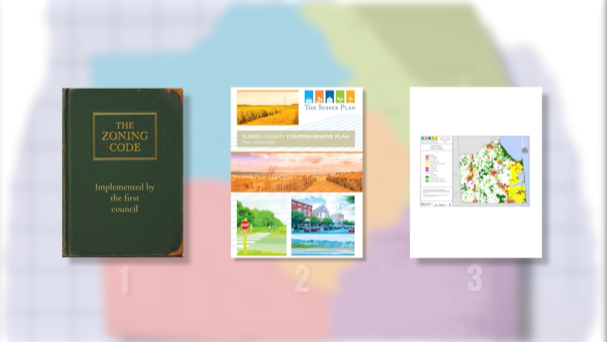
The zoning code, comprehensive land use plan, and future land use map shape land use decisions in Sussex County.
Decisions are guided by three documents: the zoning code from the 1970s, the comprehensive land use plan, updated every 10 years and approved by the governor; and the future land use map, which carries the force of law.
“It literally tells you what can happen in certain parts of the county,” Lawson said of the map. “It takes an ordinance to even adjust that map. So it does have the force of law.”
The most recent comprehensive plan was created in 2018, with the next update required by 2028.
Why there are so many single family homes
Much of Sussex County is zoned agricultural residential, allowing two single-family homes per acre (though in reality, it's usually fewer homes than that due to buffer and setback requirements). The mass existence of AR-1 land makes houses the easiest option to build, while other types of housing or commercial projects often require rezoning that can be denied.
Developer Christian Hudson says if the future land use map had more types of inventory, like land already zoned for commercial or mixed-use properties, we'd see more of those projects.
“If I want to do anything besides building houses, I have to rezone the land,” Hudson said. “The only thing we actually can build by right is houses. And that’s why we’ve seen that.”
Hudson said developers often avoid proposals that could be rejected. That's due to the drawn out process to rezone, which can take years, and the public pushback and subsequent denials for many rezoning applications.
Those denials have happened time and time again, including a 2017 gym in Lewes, the Overbrook Town Center off Route One, and plans for the Atlantic Fields shopping center on Route 24. In both the gym and Overbrook's cases, those properties now have or will have single family homes. For Atlantic Fields, the developer has pledged to build something despite the denial.
“You’re in a business to make money, not to get rejected,” he said. “So if you’re smart, you come in with a by-right plan where everything’s all buttoned up in a nice, neat package, and you actually can’t tell me no.”
What's working
Current growth is in areas reflected in Comp Plan
Lawson said the current framework in Sussex County gives structure and predictability, particularly for areas designated for growth.
“In 2018, we changed the map, we colored it differently and we changed the area that was colored yellow. And we said we want growth there,” Lawson said. “Go out and look where the growth is happening. It’s happening in the yellow.”
Lawson points out the Comp Plan is made after years of public feedback and hearings, so the growth we are seeing now is where the public wanted to see it in 2018.
County makes multiple updates to improve development
The county has also made targeted updates, including stronger forest buffer requirements and rules that subtract wetlands from buildable land.
Land Use Reform Working Group brings unprecedented conversation and metrics for improvement
Another step county leaders point to is the creation of Sussex County’s land use reform working group. The group was formed to study growth pressures and recommend changes to zoning, density and development patterns.
Lawson said the working group brought a variety of stakeholders to the same table, such as farmers, environmentalists and developers alongside state agencies and county staff. That's something critics have long said was missing.
The working group recently delivered 20 recommendations to Sussex County Council, including proposals to allow more housing types and adjust density in some areas. In late January, Lawson and his staff presented those refined ideas to Sussex County Council, meaning in the very near future, meaningful change could come in the ways of ordinances.
What's not working
County forced to use Delaware Population Consortium, which does not keep up
Critics argue the core of the system has not kept pace with reality — and that the data guiding long-term planning can be wrong.
Delaware law requires the comprehensive plan to use the Delaware Population Consortium for population numbers and forecasts, but critics believe the consortium underestimates growth.
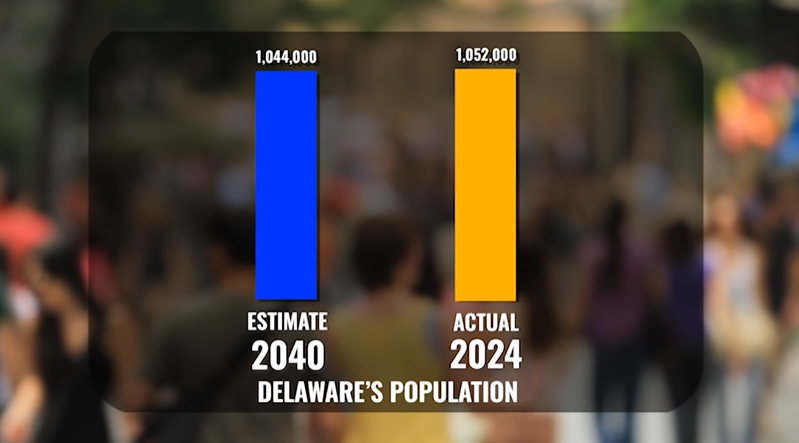
Data shows the Delaware Population Consortium has chronically underestimated Delaware's population.
"The projections that [the county is] forced to use by our state process, are almost always wrong and undershoot the actual population. And then you don't find that out until the US census data comes out ten years later," says developer Christian Hudson. "There's no accountability and then there's no change in the process. And so what ends up happening in the real world is hospitals, schools, roads, infrastructure, all of that stuff is looking at a target that is way too conservative for the actual growth that we're experiencing. So when your schools open, they are over capacity on day one. Your hospitals, your everything is projected on this number that's not actually set in reality."
Data supports Hudson's thesis.
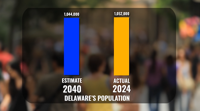
A 2020 state strategies report estimated Delaware's population to be 1,000,440 people by 2040. The U.S. Census shows Delaware surpassed that estimate in 2024, 16 years earlier than the state strategies report.
Additionally, The Delaware Population Consortium estimated Sussex County to have 270,000 in 2025. According to the U.S. Census, the county was already at 271,000 in 2024.
Delaware priorities do not align with Sussex County
Critics also point to disconnects between state and county planning. Sussex County’s future land use map, which “has the force of law,” Lawson said, does not align with the state’s strategies and spending map, the document that directs where Delaware plans to put money.
That mismatch can shape what gets funded, and where, while growth continues on the ground.
Delaware is updating its strategies for state policies and spending, recently certified by Governor Matt Meyer. But that does not change the past plan and the hundreds of decisions made in Sussex County during that time.
Roads and coordination challenges
Even major land use reforms would not fix one of the biggest complaints: traffic. Roads are controlled by the state, not the county, and DelDOT has said it cannot expand infrastructure at the same pace as development.
“We don’t control the roads, but we certainly influence the roads,” Lawson said. “We need our partners at DelDOT be at the table to talk about that.”
At an October review of the working group recommendations, Sussex County Council Vice President John Rieley expressed concern if any of the recommendations would make a big difference if the roads don't change.
"All of this is predicated on DelDOT recognizing that Sussex County is the fastest growing part of the state and allocating adequate resources to improve the transportation system," Rieley said. "They ignore their own map. This is a very frustrating process. If we just jam more people in a smaller area without the adequate infrastructure, i.e. roads, what are we doing?"
Critics say coordination among Sussex County, DelDOT and state planning agencies has been inefficient, and they point again to the mismatch between the state strategies map and Sussex County’s future land use map as a sign the systems are not moving in sync.
Changes to the Comprehensive Plan
Even within Sussex County’s own planning, former council members have raised concerns about how often the future land use map, "the force of law," is amended. But that force of law has been adjusted nine times in the last five years.
"I think that to be able to change the comp plan in a meeting is kind of wrong," says former Councilman I.G. Burton. "You spend two years making this comp plan, and it's going to be the comp plan for ten years. And all of a sudden somebody says, 'Hey, you know what I want to do? I'd like to change my land from this color to this color in the comp plan. I think we ought to have an ordinance that maybe says, you can do that once every five years."
Some large-scale projects including the proposed massive Cool Spring Crossing, involve changing the future land use map.
What comes next
Sussex County staffers are expected to soon bring ordinances based on the working group recommendations to Sussex County Council. Changing density and addressing a "missing middle" type of houses seem to have momentum. Other recommendations like comprehensive rezoning, were described as "lofty."
Hudson said meaningful change requires political courage.
“It does take courage and it does take planning,” he said. “But that’s how you execute.”
Lawson warned that sweeping changes could lead to lawsuits from developers who relied on existing rules.
“If we, the rule makers, change the rules in the middle of the game, that’s probably unfair, if not illegal,” Lawson said.
Some newly elected council members have floated the idea of a development moratorium, but even a pause would not stop years of already-approved projects from moving forward.
As Sussex County works toward a new comprehensive plan by 2028, and Delaware updates its state strategies, the debate continues over how to balance growth, infrastructure and the way of life many say is slipping away.
